

Description
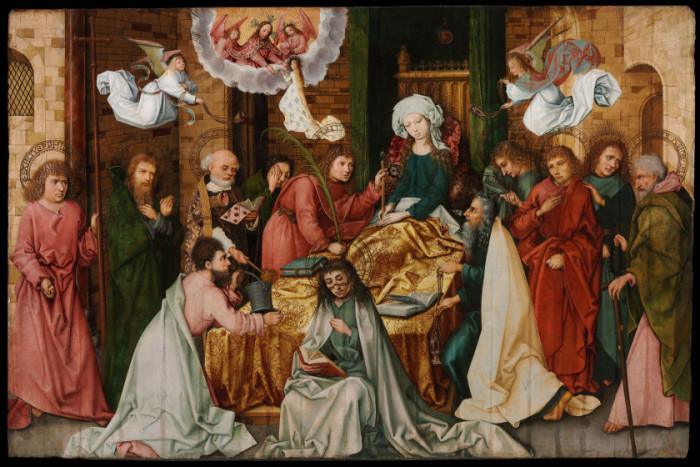
The painting shows the Dormition of the Virgin inside a solemn architectural space framed by stone arches, columns, and dark wood paneling. At the center, Mary, dressed in shades of greenish blue and red, leans over a bed covered with a golden cloth. A large group of figures gathers around her: men of different ages, some bearded, kneeling, leaning forward, or clasping their hands in mourning and prayer. An open book rests on the cloth, while a broad white drape fills the right foreground. Above the earthly scene, several winged figures emerge among pale clouds, extending the event into the celestial realm.
The Dormition of the Virgin depicts the death or passing of Mary, traditionally accompanied by the apostles gathered at her bedside. The work thus brings together two inseparable dimensions: the physical presence of those attending her final moments and the promise of spiritual continuity. The figures surrounding the Virgin form a community of witnesses; their bowed postures and restrained gestures convey grief without turning the scene into one of agitation. Above, the angels and clouds open the space onto a transcendent realm, so that the episode is read simultaneously as a farewell and as a passage into the celestial sphere.
The circular halos distributed among the figures serve as signs of holiness and help arrange the crowd according to devotional importance. The golden cloth draws attention to the center beneath Mary, as if the bed had become the material heart of the rite. The open book introduces a reference to prayer, sacred reading, and shared memory. In contrast to the horizontal solemnity of the reclining body, the winged figures bring an upward movement: their suspended bodies and the formation of clouds connect the architectural interior with a higher realm. The contrast between the white cloth in the foreground and the reds, greens, and golds reinforces the solemnity of the gestures.
The composition is organized with notable clarity despite the density of figures. The central figure establishes a visual axis around which the groups on either side are arranged, while the arches and columns frame the scene and stabilize its horizontal breadth. The diagonals formed by the leaning bodies lead the eye toward the golden bed; then the angels’ upward rhythm shifts attention toward the clouds. The intense colors of the robes stand out against the dark wood and stone, while the light-colored surfaces—faces, pages, fabrics, and clouds—serve as points of light. The variety of poses avoids rigidity and turns the crowd into a group of individual responses to the same event.
Associated with Hans Holbein the Elder, the work belongs to German religious painting from the transitional period between the Late Gothic and the Northern Renaissance. His preference for densely populated compositions, meticulous depictions of figures, architectural interiors, and golden accents heightens the scene’s devotional character. It is worth noting how each element contributes to a single progression: the architecture contains the grief, the golden bed focuses attention on Mary’s presence, and the group of angels lifts the narrative beyond the earthly realm. The painting’s power stems precisely from this collective drama, in which fabrics, halos, gestures, and clouds transform a silent farewell into a vision of spiritual passage.
Have questions about our oil painting reproductions? See our frequently asked questions.