



Description
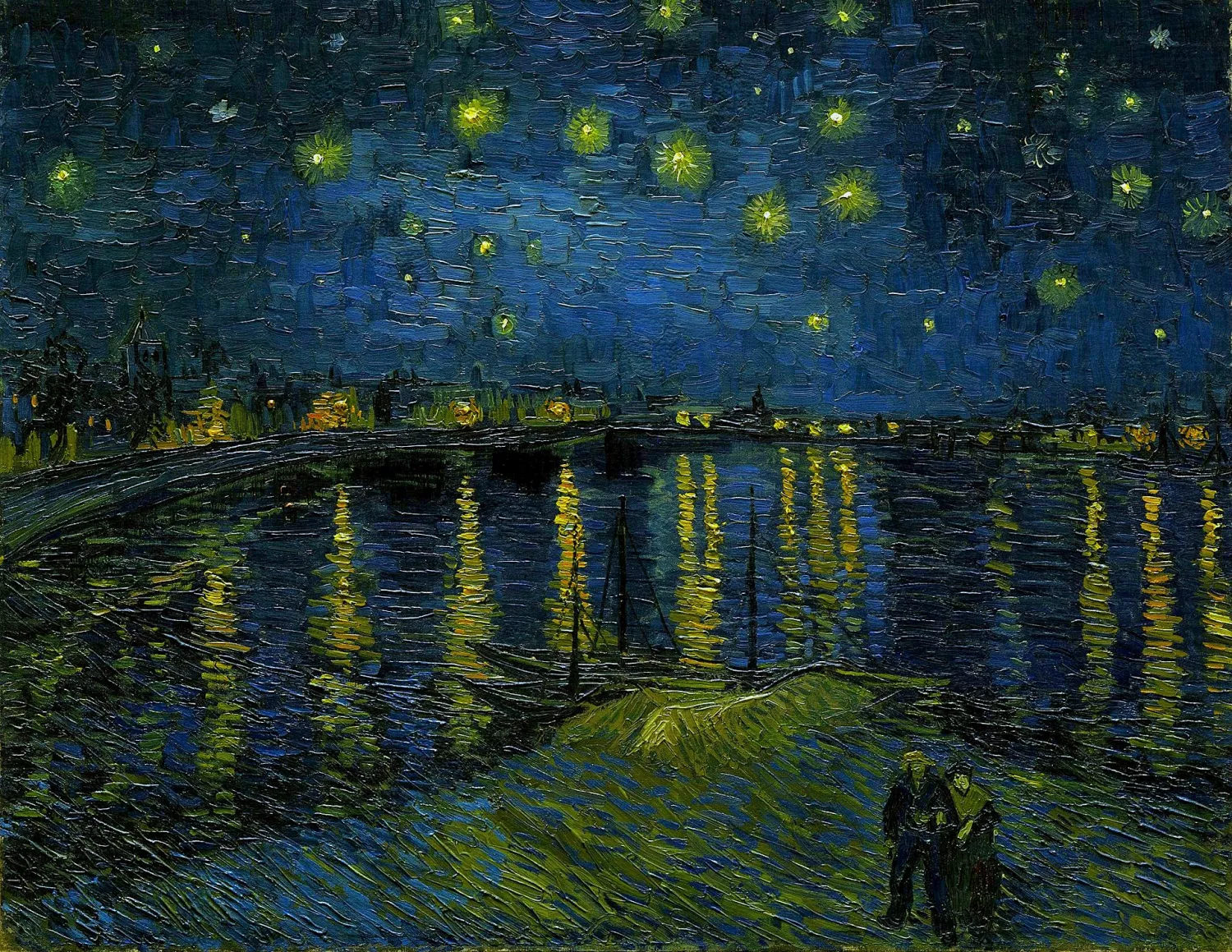
The painting shows a nighttime view of the Rhône in Arles, stretching out like a broad, dark surface beneath a deep blue sky. On the far bank, a line of buildings and city lights runs along the horizon; a slender tower stands out to the left, reinforcing the sense of a riverside city. The lights extend across the water in golden, yellow and greenish reflections. In the foreground, a dark boat with masts introduces a strong, tangible vertical presence, while two figures stand together in the lower-right corner, beside the riverbank. The scene brings together city, river, boat and human presence in a quiet, contemplative composition.
Vincent van Gogh created this painting in 1888, during his time in Arles, transforming an everyday riverside landscape into an intensely poetic experience of the night. The subject does not depend on dramatic action: its narrative arises from the encounter between the illuminated city, the course of the Rhône and the people contemplating it from the bank. The lights of Arles appear in the distance as a lively strip, while the river opens up a space of stillness between the viewer and the city. The boat and the figures provide a sense of scale and place the viewer’s gaze in a lived-in world, rather than an abstract or uninhabited landscape.
The starry sky dominates the visual experience and concentrates a poetic, contemplative intensity. Its stars, rendered as luminous yellow and greenish strokes, engage in a dialogue with the artificial lights on the bank: above and below, two constellations appear, one natural and the other urban. The golden reflections turn the water into a luminous extension of the city and break through the darkness with a vertical rhythm. The couple in the foreground introduces an intimate human scale, as if the walk and the act of contemplation were the emotional heart of the scene. The boat, with its masts and rigging, anchors this lyrical dimension in an everyday, tangible setting.
The horizontal composition is organized into a sequence of bands: the sky occupies the upper section, the city forms a horizon line, and the water dominates the center and foreground. The visible, undulating brushstrokes make the surface of the river seem to shimmer, while fragmented columns of light guide the eye down from the shore. The contrast between cobalt and greenish blues and golden yellows draws attention to the points of light. The figures and the boat balance the lower-right area against the broad expanse of water, while their dark forms provide a steady counterpoint to the shifting rhythm of the reflections.
The work exemplifies Vincent Van Gogh’s interest in landscape, nocturnal light, and expressive color. Rather than dissolving the scene, the brushstrokes build its energy: the sky comes alive with movement, the water responds to the lights, and the night becomes an active field of color. The painting transforms a riverside view into a dialogue between stars, city, and reflections, with every source of light echoed on the river’s surface. When viewing the painting, it is worth following this vertical path from the stars down to the water and observing how the couple and the boat bring a human scale to a landscape dominated by the vastness of blue.
Have questions about our oil painting reproductions? See our frequently asked questions.