

Description
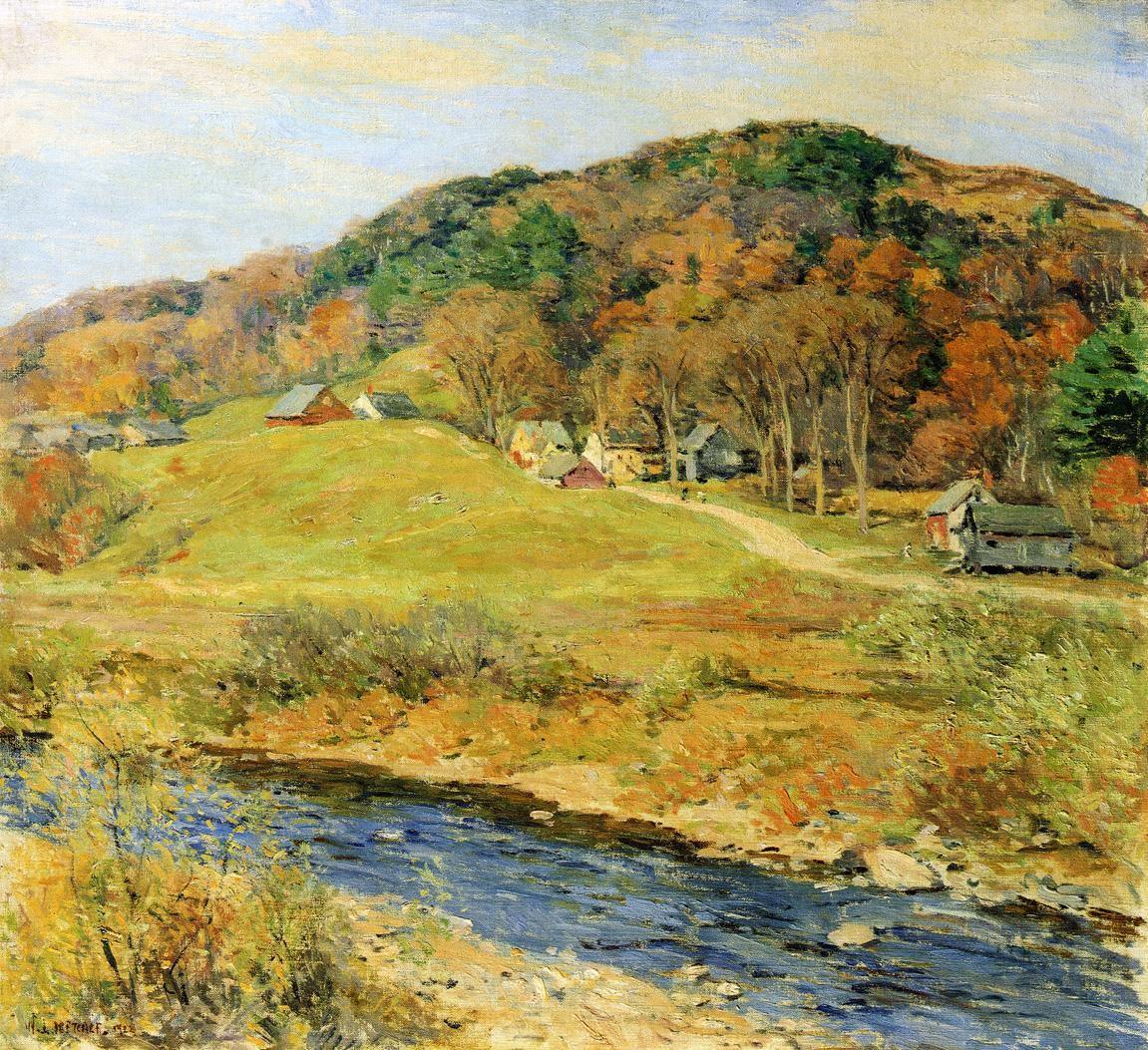
The painting depicts a rural mountain landscape in the midst of autumn. A rounded hill, covered in a woodland of greens, yellows, ochres, oranges, and browns, dominates the background and concentrates the scene’s richest colors. At its foot lies an open, gently sloping meadow, dotted with several small buildings with pitched roofs. A light-colored path descends from this area toward the right, while a long rural building runs alongside the edge of the field. In the foreground, a blue stream crosses the composition diagonally amid grasses, shrubs, and stones, leading the eye toward the inhabited area.
As a landscape, the work does not depict a specific historical, religious, or mythological episode; its subject is the relationship between nature and rural life during a season of change. The title, November Mosaic, sums up the poetic evocation of a field where the foliage brings together lingering greens with golden, reddish, and earthy tones. The buildings, path, and stream place the natural setting on a human scale, even though no figures appear in the scene. In the landscape tradition, land, sky, water, and architecture are arranged to transform an ordinary place into a visual experience of contemplation.
The variety of the foliage gives meaning to the “mosaic” in the title: each group of trees contributes a different patch of color to the hillside. The partially bare trees and mix of colors reinforce the association with autumn’s transition and the passage of time. The stream connects the cool tones of the sky and water with the greens and ochres along its banks, while the path and buildings provide subtle signs of human presence. They do not disturb the stillness of the surroundings, but make them feel inhabited. The diagonal current brings continuity and movement to a scene dominated by the hill’s serenity and the meadow’s breadth.
The composition is arranged in stepped planes. The stream occupies the lower band, creating depth through its diagonal course, bright reflections, and rocks that interrupt its flow. The meadow serves as a luminous expanse, leading the eye toward the buildings and the path. Behind it, the wooded mass forms a broad arc that encloses the space without making it feel heavy: shifts in color break up its surface and create visual rhythm. The pale sky, crossed by soft clouds, lets the upper part breathe and enhances the overall clarity. The eye rises from the water to the meadow and then to the hill, moving from nearby details to the breadth of the landscape.
In the context of Willard Leroy Metcalf’s work, this painting is associated with an Impressionist-leaning sensibility for landscape, attentive to the luminosity of color and to atmospheric and seasonal effects in rural settings. That sensibility is expressed here in the hillside’s vibrancy and in the interplay of autumn’s warm tones with the blues of the water and sky. The result depends not on a narrative event, but on the interplay of light, season, and inhabited space. The stream brings movement to an essentially still scene and leads the eye toward the forest, the expressive heart of November Mosaic.
Have questions about our oil painting reproductions? See our frequently asked questions.