

Description
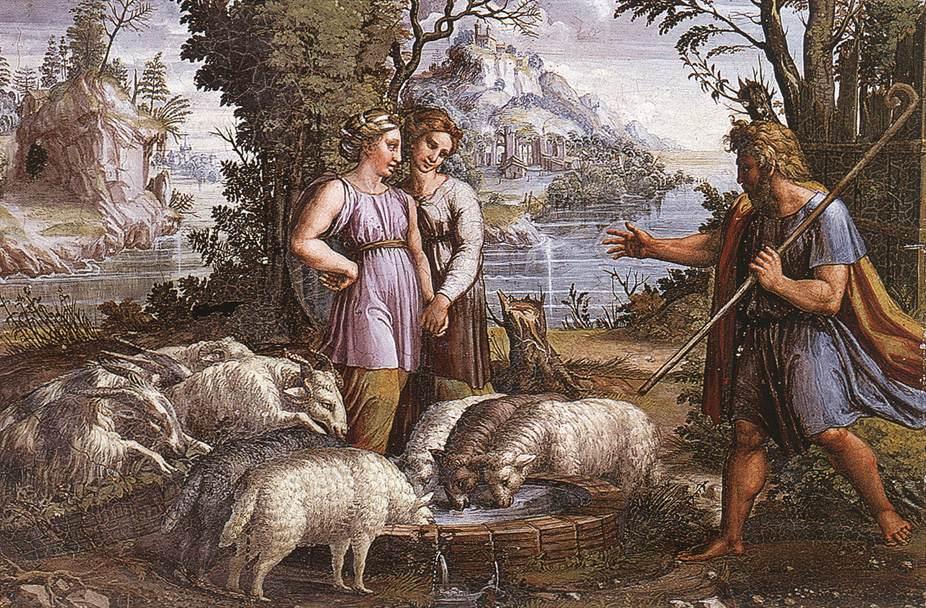
The painting depicts Jacob Meeting Rachel as a pastoral scene unfolded beside a broad body of water. Two female figures occupy the center, while a bearded man wearing a blue tunic and reddish cloak approaches from the right carrying a long staff. The orientation of his body and his outstretched gesture establish a visual relationship with the women. In the foreground, sheep and pigs cluster around a rectangular wooden trough, amid low vegetation, reeds and rocks. The lake, leafy trees, mountains and the classical architecture in the background extend the scene into an idealized ancient landscape.
The episode comes from the Genesis narrative and recounts Jacob’s meeting with Rachel beside a well in Haran. Rachel, daughter of Laban, is traditionally associated with tending her father’s flocks. According to the biblical account, Jacob assists Rachel in accessing the water by moving the stone that covers the well, a gesture that precedes the development of his relationship with Laban’s family. The composition transposes this episode to an open, theatrical setting: the water dominates the middle ground and focuses attention on the approach of the figures, without literally representing every detail of the story.
The animals introduce the pastoral world and connect the religious dimension with everyday life. The sheep allude to Rachel’s role in caring for the flocks, while the pigs and the trough provide a domestic, earthly presence in the foreground. The staff elongates Jacob’s silhouette and reinforces his status as a traveler and man of the fields. The grouping of the two women and the man concentrates the narrative on recognition and approach; the second female figure enlarges the human nucleus of the scene without displacing the primacy of the meeting. The water functions as an axis of transit and bond, and the classical architecture imparts an timeless atmosphere to the biblical tale.
The horizontal structure guides the gaze through successive planes. The vessel and the animals occupy the lower area, built with compact volumes and light tones, and lead attention toward the figures. From there, the lilac, blue and muted red garments stand out against the greens and browns of the landscape. The staff introduces a dynamic diagonal rising to the right, while the dark trees frame the edges and open the center toward the lake, the mountains and the colonnaded building. The contrast between the shadow of the foliage and the clarity of the water and slopes creates depth and alternates intimacy with expanse.
The work expresses the religious subject through a serene pastoral language, balancing figures, nature and architecture in a composition that reads like an outdoor stage set. The landscape does not act as a mere backdrop: the water both separates and connects the different planes, the mountains prolong the line of sight and the trees frame the characters’ approach. The glances, the staff and the placement of the animals form a network of directions that leads from daily activity to the bond between Jacob and Rachel. In this way, an episode from the biblical tradition becomes an image of encounter and recognition, whose visual power lies in the harmony between the human narrative and the breadth of the landscape.
Do you have questions about our oil-painting reproductions? See our frequently asked questions.