

Description
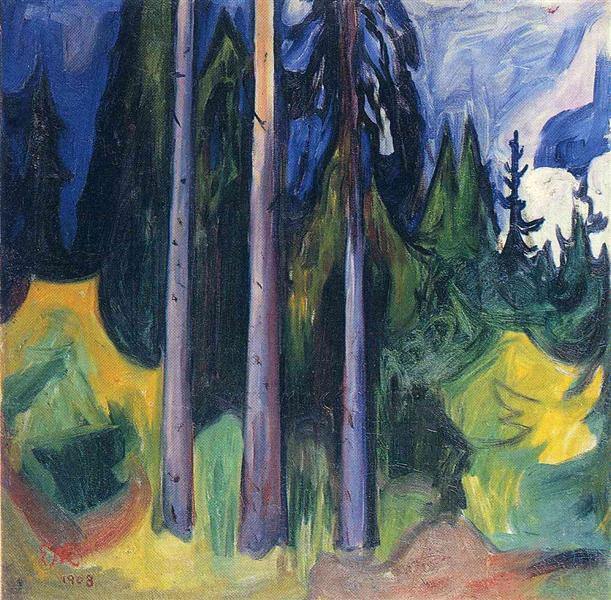
The painting depicts a dense, vertical forest, built around several tall trunks that rise from the foreground to the top of the composition. Their pale bark, nuanced with cream, lilac and gray, stands out against the deep masses of bluish-green conifers that fill the background. Low, dense vegetation with vigorous brushwork stretches along both sides, interrupted by yellow and green clearings that illuminate the undergrowth. Blue areas appear between the treetops and trunks, opening up the space to greater depth, while the ground below brings together muted browns, pinks and reds. There are no human figures: the entire visual experience is focused on the thicket, the silence and the viewer’s gaze moving into the landscape.
As a landscape, Forest does not rely on a historical or religious narrative to sustain its interest. The work belongs to a tradition in which nature can function both as a physical setting and as a state of mind. Here, the forest appears less as a place described with topographical precision than as a space of perception: enclosed by shadows, yet traversed by luminous openings and a bluish band that introduces air and distance. In this context, Edvard Munch’s name places the scene within an expressive approach to landscape, in which the arrangement of color and the intensity of forms matter as much as identifying the place depicted.
The central trunks form a succession of axes that guides the eye and creates the sensation of moving among the trees. Their repetition can be read as a rhythm of footsteps: each vertical line partially conceals and reveals what lies behind it. The yellow and green clearings act as points of light that break through the dark density, while the blue background offers a visual escape from the forest’s enclosed atmosphere. The contrast between shelter and openness, shadow and radiance, gives the landscape an emotional dimension without the need for figures or narrative symbols. The lilac and reddish coloring of the bark and ground takes the scene beyond purely naturalistic observation, transforming it into a more intense and subjective experience.
The vertical composition concentrates the visual weight in the parallel trunks at the center, while the masses of conifers on the left and right balance this structure and frame the clearings in the undergrowth. Depth is built up in layers: the uneven ground fills the lower area, the vegetation in the middle distance connects the foreground with the secondary trees, and the blue areas in the background widen the space between the treetops. The compact brushwork of the shrubs contrasts with the more elongated strokes of the trunks, creating an alternation between stillness and movement. Color does more than describe the light: it structures the landscape, separates the planes, and directs attention from the lower clearings toward the opening above.
In general, this work reflects an expressive aspect associated with Edvard Munch: simplified forms, emotionally charged colors, and a space constructed through chromatic contrasts and linear rhythms. In Forest, nature is not presented as a neutral backdrop, but as a structure that envelops the viewer and guides their visual journey. It is worth observing how the light-colored trunks seem to lead into the distance, while the yellow clearings interrupt this recession and draw the gaze back to the foreground. In this tension between density and openness, Munch transforms a silent motif into a spatial and emotional experience: the forest is contemplated, but also traversed by the gaze.
Have questions about our oil painting reproductions? See our frequently asked questions.