

Description
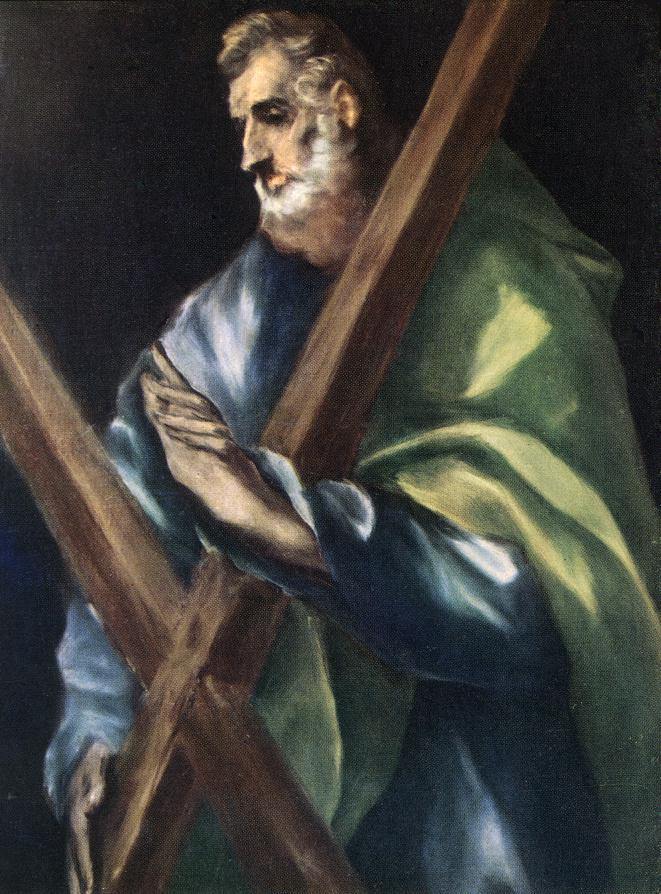
The painting shows Saint Andrew in a close, vertical composition, depicted from the waist up as he holds a large wooden cross. The bearded apostle, his face turned to the left, occupies the center of the composition; his hands clasp the beam, focusing the action where the main lines intersect. The wood rises diagonally from the lower left toward the upper right, crossing the space in front of his torso. The ample garments, in dark blue and deep green, envelop the figure in visible folds and light reflections. Behind him, the almost-black background removes any reference to the surroundings and leaves the saint isolated before the viewer.
Saint Andrew was one of the twelve apostles of Jesus Christ and, according to Christian tradition, the brother of Simon Peter. He is identified here by the cross, an attribute associated with his martyrdom and known as the Cross of Saint Andrew. The instrument of the Passion does not appear as a secondary object placed beside the figure: it is what the saint holds and presents, so the story is physically embodied in his posture. The scene thus brings together apostolic identity, the memory of martyrdom and an attitude of contemplation that transforms the religious episode into an image for reflection.
The cross functions simultaneously as a narrative sign and a visual structure. Its presence identifies Saint Andrew, while the pressure of his hands against the wood makes this contact the spiritual center of the scene. The beard, serene expression and solemn face contribute to an apostolic characterization, far removed from any anecdotal gesture. The dark background and deep-toned garments isolate the figure, as if everything unrelated to the saint and his attribute had been removed. In this context, the light on the hands intensifies the connection between the human body and the symbol of sacrifice.
The formal composition depends on a precise contrast between stillness and movement. The figure remains steady and frontal, but the diagonal of the cross introduces a current that guides the gaze from the lower beam to the hands, the chest, and finally the face. The lighting focuses attention on the face, the fingers, and certain folds in the blue and green garments, making these areas gradually emerge from the darkness. The elongated fingers and ample drapery extend the lines of the cross and lend the figure a vertical, expressive presence. The close framing narrows the distance between the viewer and the apostle, while the surrounding dark void heightens the devotional intensity.
This work by El Greco displays traits widely associated with his style: elongated proportions, intense colors, dramatic lighting, and a pronounced spiritual focus. The painting needs neither landscape nor architecture to expand its meaning; it organizes the entire experience around the body, the wood, and the light. Notice how the hands connect the material presence of the cross with the expression on the face: the complete reading of the work unfolds between these two areas. Saint Andrew does not merely appear beside his attribute; he is formally joined to it, while the diagonal transforms the story of his martyrdom into a silent vision of faith and contemplation.
Have questions about our oil painting reproductions? See our frequently asked questions.