
Description
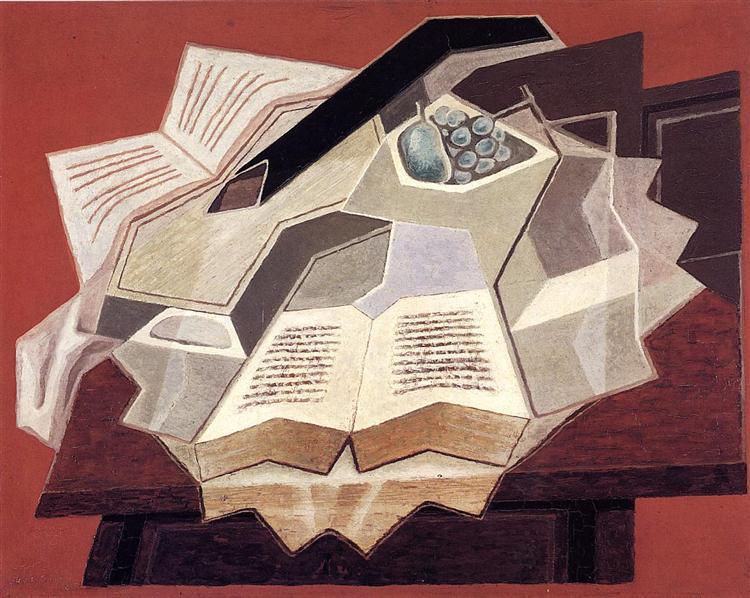
The work presents a Cubist still life in which the open book organizes the gaze and gives meaning to the whole. In the lower area, an unfolded notebook shows two pages covered in dark lines, while another open book appears in the upper left. Between them spreads a network of loose sheets, folded papers and overlapping surfaces that occupy the center and extend toward the right. Above, a clear vessel contains a bluish-green bottle and several rounded objects of bluish-gray tone. Everything rests on a dark table, defined by sharp angles and planes against a brick-red background.
As a still life, The Open Book does not depend on a narrative action but on the carefully ordered presence of everyday objects. The painting turns a reading and work table into a space for contemplation where knowledge, writing and domestic materiality coexist. The books and papers refer to reading and intellectual activity, while the bottle and the elements gathered in the vessel introduce a practical, familiar and tangible dimension. This combination places the work within a tradition that uses inanimate objects to study form, material and the balance of a composition.
The open book here functions as a sign of knowledge, but also as a visually rich surface. Its lines of text, although they do not form legible content, provide rhythm and direction; they turn the pages into fields of strokes that converse with the folds and edges of the nearby sheets. The overlapping papers suggest an ongoing intellectual activity, suspended at the moment when the table is set before the viewer. Opposite them, the bottle and the rounded objects introduce more compact, material forms. The contrast between the flat surfaces of the books and the grouped volumes in the vessel reinforces the tension between thought, everyday use and physical presence.
The composition is built frontally, without a dominant illusionistic depth. The two books trace a diagonal that leads from the upper left toward the lower center, where the most visible page becomes the main focal point. The sheets extend that movement to the right, while the vessel and the bottle balance the upper area. Rectangular and angular planes fragment the table, the papers and the objects, so that each element preserves its identity while at the same time participating in a larger geometric structure. The brick-red background intensifies the cream, ivory and gray tones; the browns and blacks give weight to the table, and the blue-green introduces a cool counterpoint that prevents chromatic uniformity.
The connection to Juan Gris is especially clear in this synthesis of recognizable objects and geometric construction. A central figure of Cubism, Gris developed still lifes defined by precise planes, balanced color relationships and an organization that transforms representation into visual architecture. In The Open Book, that architecture makes reading the scene also mean traversing it: from the lower page to the upper book, from the leaves to the container and from the rounded forms to the dark edges of the table. It is worth noting how the motif of the book ceases to be merely a represented object and becomes the axis that articulates lines, colors and planes, linking the idea of reading with the very structure of the painting.
Do you have questions about our handmade oil-painting reproductions? See our frequently asked questions.