

Description
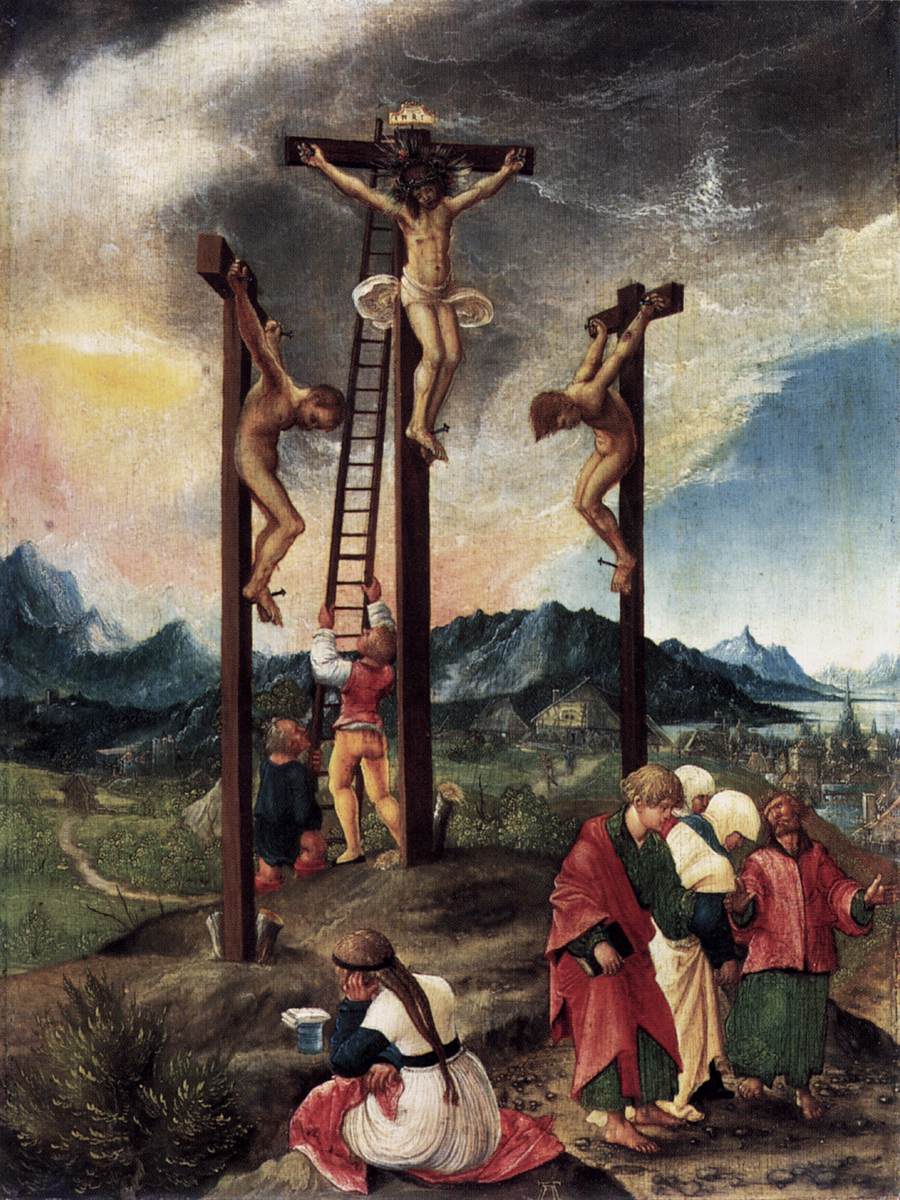
The painting depicts the Crucifixion on an open hillside, dominated by three wooden crosses silhouetted against a sky heavy with clouds. Christ occupies the central axis, elevated above the other figures, with his arms outstretched and a light cloth around his waist. The two condemned men appear on either side, bent over their respective crosses. A ladder reaches up to the main cross, and several people gather at its base, while a larger group, dressed in reds, greens, whites, and yellows, fills the foreground. From this rocky slope, the scene extends into a valley with houses, small figures, mountains, and a body of water in the distance.
The scene depicts one of the central episodes of the Passion of Christ: his death on the cross on the mount, accompanied by two other men who have been crucified and witnessed by a scattered community. The arrangement of the three crosses follows a recognizable iconographic tradition, with Christ in the center and the two condemned men at the sides. The elevated landscape evokes Golgotha, or Calvary, and sets the sacred event in a specific, open, inhabited place. The presence of onlookers and those working around the cross connects the religious episode with a human and collective dimension.
The central cross structures both the narrative and the symbolic reading of the work. Its verticality makes Christ the spiritual and visual point of reference, while the crosses at either side expand the meaning of sacrifice and redemption. The ladder introduces a line of human intervention connecting the ground with the crucified figure; together with the people gathered at the foot of the cross, it heightens the sense of activity surrounding an irreversible event. The inhabited valley extends the scene beyond the foreground: Christ’s death is not isolated but seems to reverberate across the entire landscape. The turbulent sky reinforces this breadth and lends the episode a dramatic dimension.
The composition is vertical and centralized, yet it opens progressively into depth. The three crosses establish the main axis, while the ladder extends this upward movement toward the sky. In contrast, the foreground figures form a diagonal toward the right, leading the eye from the base of the cross toward the distant landscape. The dark tones of the mountains and clouds contrast with the creamy whites, golden ochres, intense reds, and deep greens of the garments. This alternation of colors separates the different planes and gives rhythm to the crowd. The bright patches between the clouds do not entirely soften the tension: they sharpen the contrast between the light of the sky, the atmospheric darkness, and the gravity of the event.
In Albrecht Altdorfer’s work, the religious scene is combined with a characteristic attention to landscape, atmosphere, and the meticulous construction of space. Here, The Crucifixion takes on a vast, territorial scale: the cross concentrates the sacred drama, while the mountains, valley, and sky extend it toward an almost cosmic horizon. Notice how the central figure remains visually dominant even as the eye moves toward the tiny figures in the background. This relationship between the monumental and the minuscule makes the landscape an active part of the narrative and allows the sacrifice to be perceived simultaneously as an intimate, communal, and universal event.
Have questions about our oil painting reproductions? See our frequently asked questions.