


Description
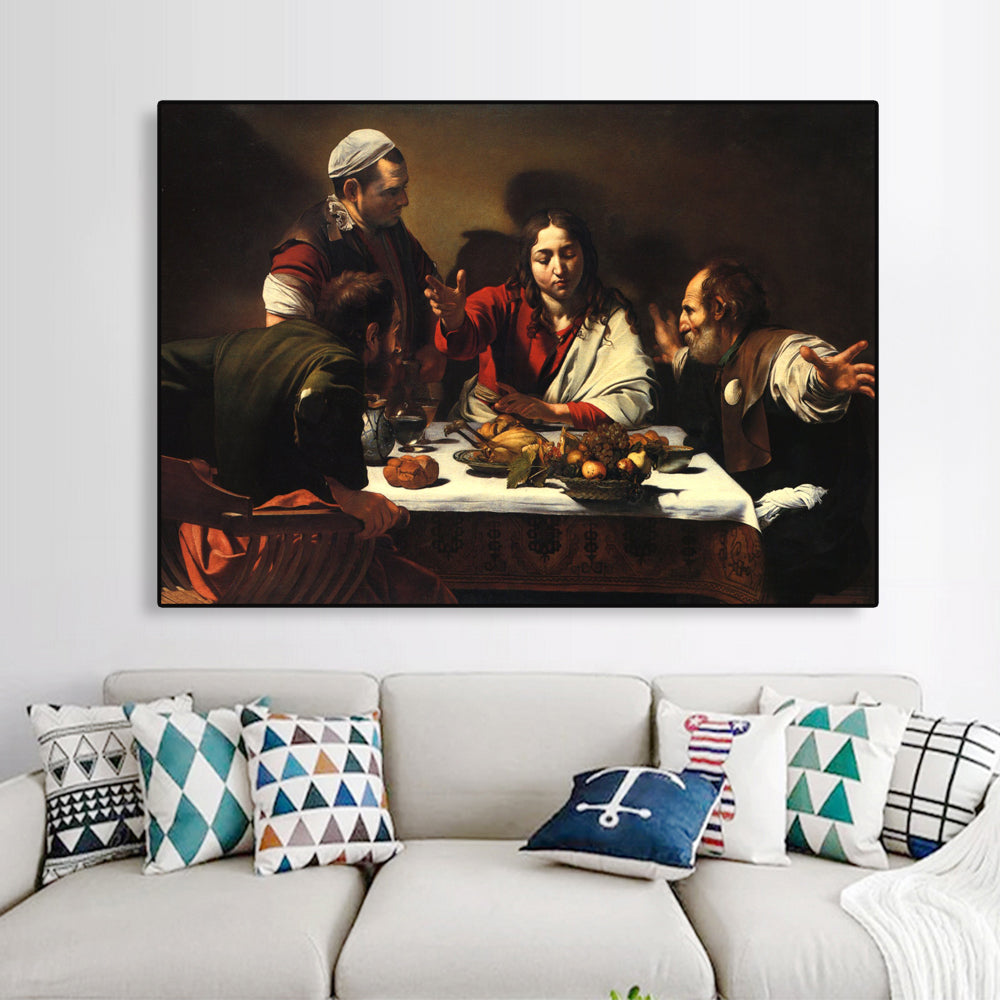
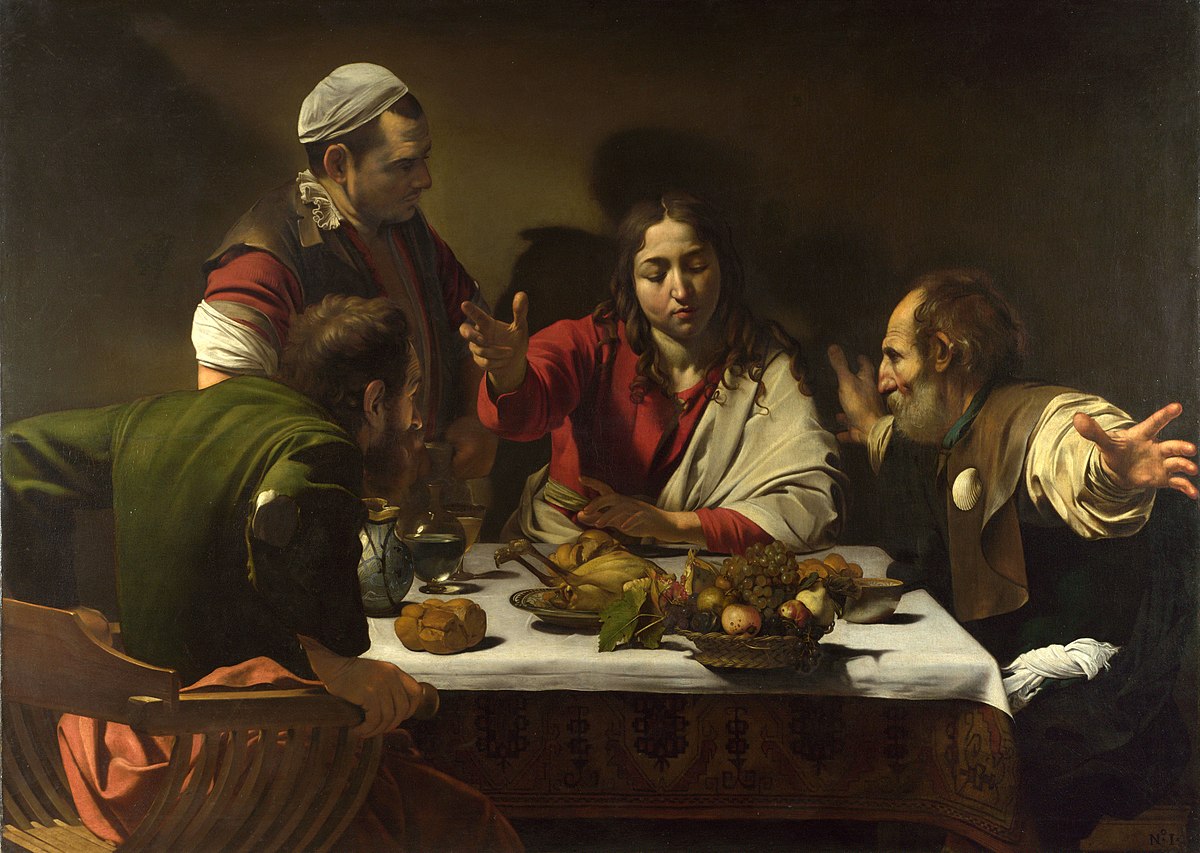
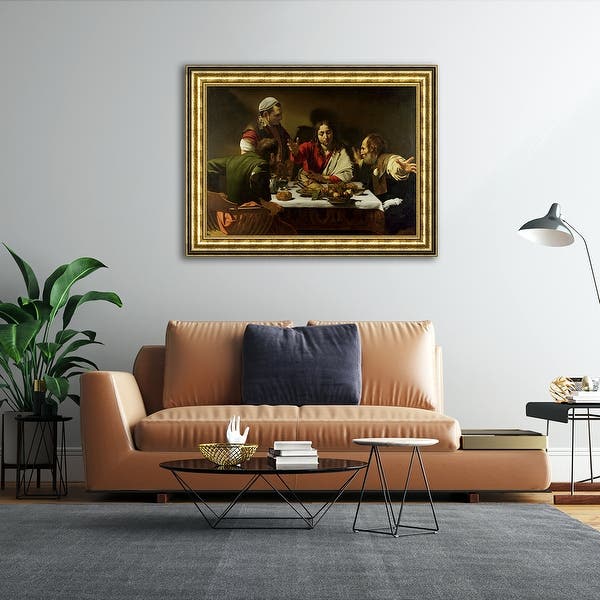
This work by the master Caravaggio is also known as The Pilgrimage of Our Lord to Emmaus or simply The Supper at Emmaus. The painting depicts the moment when the two apostles who accompany him realise that the person who has been speaking with them all day is their beloved teacher.
Painted at the height of the artist’s fame, this is one of the most striking religious paintings in the history of art. In it Caravaggio brilliantly captures the dramatic climax of the moment, the exact second when the disciples suddenly understand who has been standing before them from the beginning. Their movements and natural reactions convey their dramatic astonishment: one is about to spring from his chair while the other stretches out his arms in a gesture of disbelief. The stark lighting underscores the intensity of the entire scene.
In the work, Caravaggio depicts the disciples as ordinary labourers, with bearded, weathered faces and ragged clothing, in contrast to the young, clean-shaven Christ, who seems to have arrived from a different world.
There are some secrets hidden in various spots. For example, the artist concealed an Easter egg in the painting. The shadow cast by the basket of fruit on the table also appears to depict a fish, which could be an allusion to the great miracle.
And there are more treasures hidden in this masterpiece. Sometimes a flaw is not a flaw at all, but a stroke of genius. Take, for example, the wicker weave of the basket that teeters on the edge of the table at the centre of the composition.
Although countless eyes have marvelled at the mysterious drama unfolding in the dim interior of that inn, the meaning of an almost imperceptible imperfection has until now gone unnoticed across the centuries.
A loose twig, protruding from the braid of the weave, transforms Caravaggio’s celebrated canvas into a bold act, a spiritual challenge to the viewer.
To appreciate all the implications of this small detail, it is worth recalling the contours of the wider setting that Caravaggio was evoking in his work.
The theme of The Supper at Emmaus has inspired great masters through history, from Rembrandt to Velázquez. The key moment is narrated in the Gospel of Luke in the New Testament. There the intimate meal of Christ with the two disciples, Luke and Cleopas, is recounted, as they fail to recognise the true identity of their companion. In the painting the bread has already been broken and blessed, and, according to the Gospel account, the moment has come for Christ to “open” the eyes of his followers and to disappear “from their sight.”
The masterpiece captures a mystical threshold between shadow and light, the magical second before Christ, who is framed by the silhouette of a stranger behind him, vanishes from the world. In that immeasurable instant between revelation and disappearance, Caravaggio weaves his narrative: the masterful meeting of two worlds.
When the truth is revealed, Cleopas, the paternal uncle of Christ, rises from his chair seized by panic and wonder at the disclosure: his elbows lift dynamically through the sleeves of his cloak.
On the other side of the wicker fruit-basket, to the right, Luke throws his arms wide open, as if protesting the implausibility of the scene, drawing the same posture as on the cross at the moment of his painful death. Meanwhile, the innkeeper remains unmoved, watching without comprehension as he hears the words Christ has spoken to his astonished disciples, unable to grasp the meaning of a moment that is transcendent for humanity.
Caravaggio must have been fully aware as he choreographed this extraordinary scene, balancing it between the perishable realm and one beyond. One thing is to illustrate a moment of revelation that other artists have dared to capture in art. Another is to make the viewers of his work truly participate in the wonder of the epiphany: to turn the canvas into the very stage where a spiritual awakening is both possible and real.
There, in that moment of collective astonishment, the beloved Son of God, the expected Messiah, has become present and fulfils the scriptures in full.
The choice of fruit on the table is deliberate as well, of course; combined with the other elements on the table, they carry symbolic meaning. The apple, here rotting, represents the symbol of temptation and the fall of man. The coming of Christ is symbolised by the ray of light refracted through the glass vessel on the tablecloth, which can be read as a symbol of the virginal birth — the light penetrates the glass without breaking it — and the bread is readily recognisable as a symbol of Christ’s body, his incarnation.
Finally, the sacrifice of Christ is symbolised by the grapes that Bellori criticised. The grapes are the source of the wine, which, in the Roman Catholic Eucharist, becomes the Blood of Christ. Consequently, Caravaggio used the basket of fruit to emphasise and reinforce the meaning of the story he painted.
Caravaggio chose to represent in this work a dramatic moment in the history of humanity, namely that fraction of a second in which two close apostles realise they are witnessing a miracle of unimaginable power. The great artist freezes the instant with mastery. The artist makes that moment permanent, while allowing the viewer to take their time, consider the miracle captured on the canvas and feel the shock and wonder experienced by the two apostles.
This is without doubt a true masterpiece of the Renaissance and a religious painting favoured by the Kuadros team.
The Supper at Emmaus ranks No. 82 on the list of famous paintings