




Description
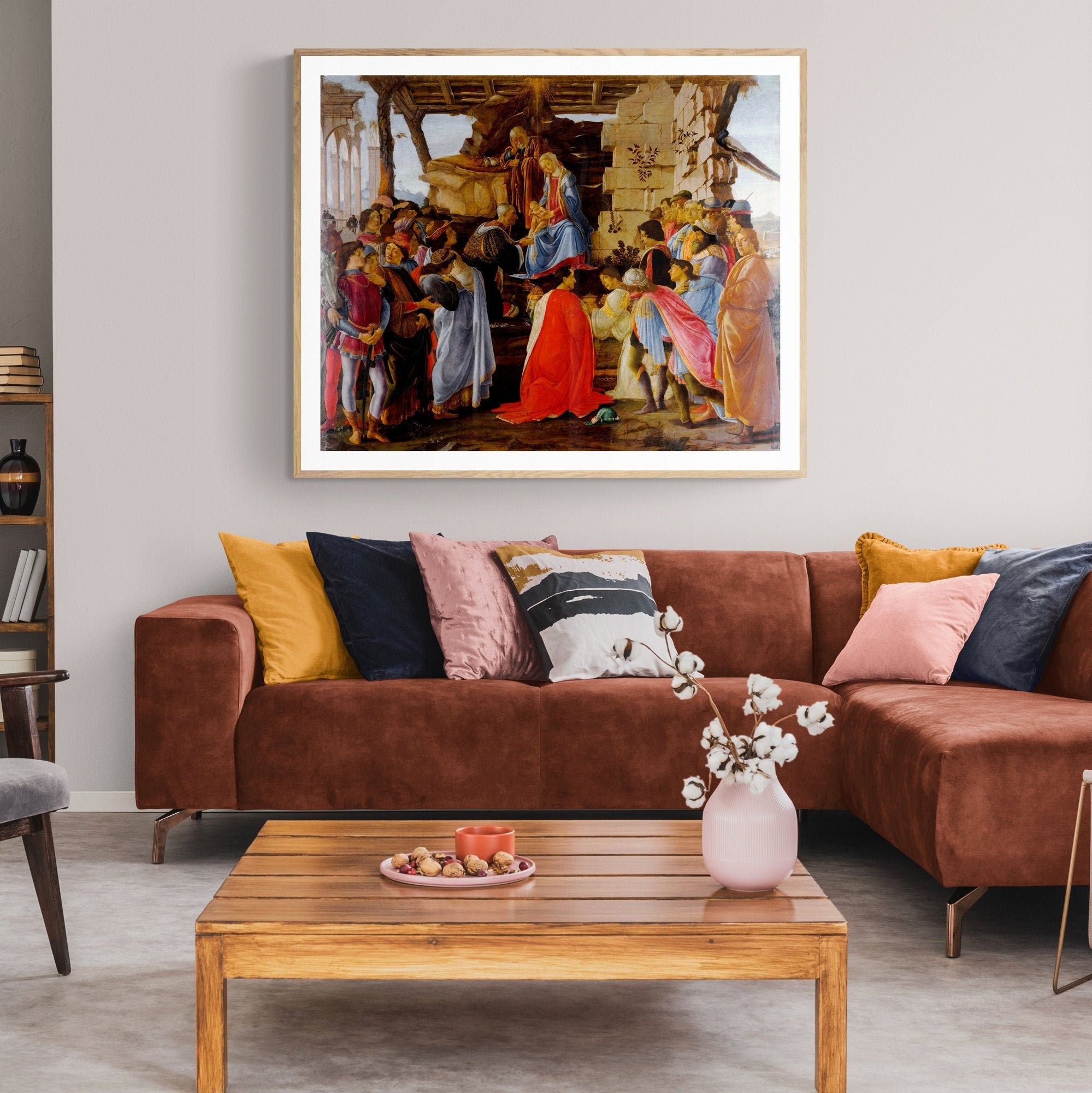
The painting shows the Virgin seated at the center of a ruined shelter, holding the Christ Child as a crowd of visitors gathers around her. The naked, luminous baby occupies the space directly in front of her; behind them, a bearded old man leans on a staff, while other figures bow, converse, or gaze toward the sacred group. The figures wear cloaks, tunics, hats, and headdresses in vivid colors: reds, blues, yellows, greens, and ochres turn the gathering into a scene of many voices. A wooden canopy and vegetation stretch above them; on the right, a cracked stone wall supports a bird with dark and light plumage. A colonnade and a mountainous landscape bathed in light open up among the ruins.
The scene depicts the arrival of the Magi to pay homage to the Christ Child, accompanied by the Virgin. The episode belongs to the Christian Nativity cycle and shows Christ before visitors from distant lands. The variety of garments, ages, and attitudes expands the event beyond a private encounter: adoration becomes a collective response to the sacred birth. The deteriorated architecture places the episode in a humble, ancient setting, a familiar backdrop for the Nativity that links the aging world of the ruins with the promise of a new Christian era.
The Virgin and Child form the devotional focus toward which almost every direction in the scene converges. The bowed figures in the foreground, the profiles at the sides and the figures peering out from the rows behind create a movement of homage that leads the eye to the center. The variety of garments and headdresses suggests the visitors’ diverse origins and ranks, while the gathering of bodies reinforces the ceremony’s crowded character. The golden vessel on the ground adds a material accent to the foreground and accompanies, without distracting from, the gesture of offering that organizes the composition.
Formally, the work is structured as a densely populated horizontal band, contained by the diagonals of the groups at the sides and by the irregular roof of the building. The large red cloak of the seated figure seen from behind establishes a visual axis in the lower area and draws the eye upward toward the blue of the Virgin’s dress and the Child’s pale body. The vivid colors stand out against the browns of the wood, stone and vegetation, while the outdoor light defines the figures’ profiles and opens up depth between the columns. The contrast between the shelter’s shadows and the luminous landscape in the background transforms the ruins into a frame that focuses attention on the central apparition rather than concealing it.
This work by Sandro Botticelli reflects the Florentine Renaissance sensibility associated with refined linear drawing, figures of stylized elegance, and densely composed scenes structured through gestures and visual rhythms. The narrative does not depend on a single action, but on the interplay of glances, inclinations, folds, and colors that arrange the crowd around a serene presence. It is worth observing how the apparent disorder of the gathering is balanced by the still center of the Virgin and Child: the ruins, visitors, and open landscape converge to transform the Adoration of the Magi into a meeting between human history and the sacred event.
Have questions about our oil painting reproductions? See our frequently asked questions.