

Description
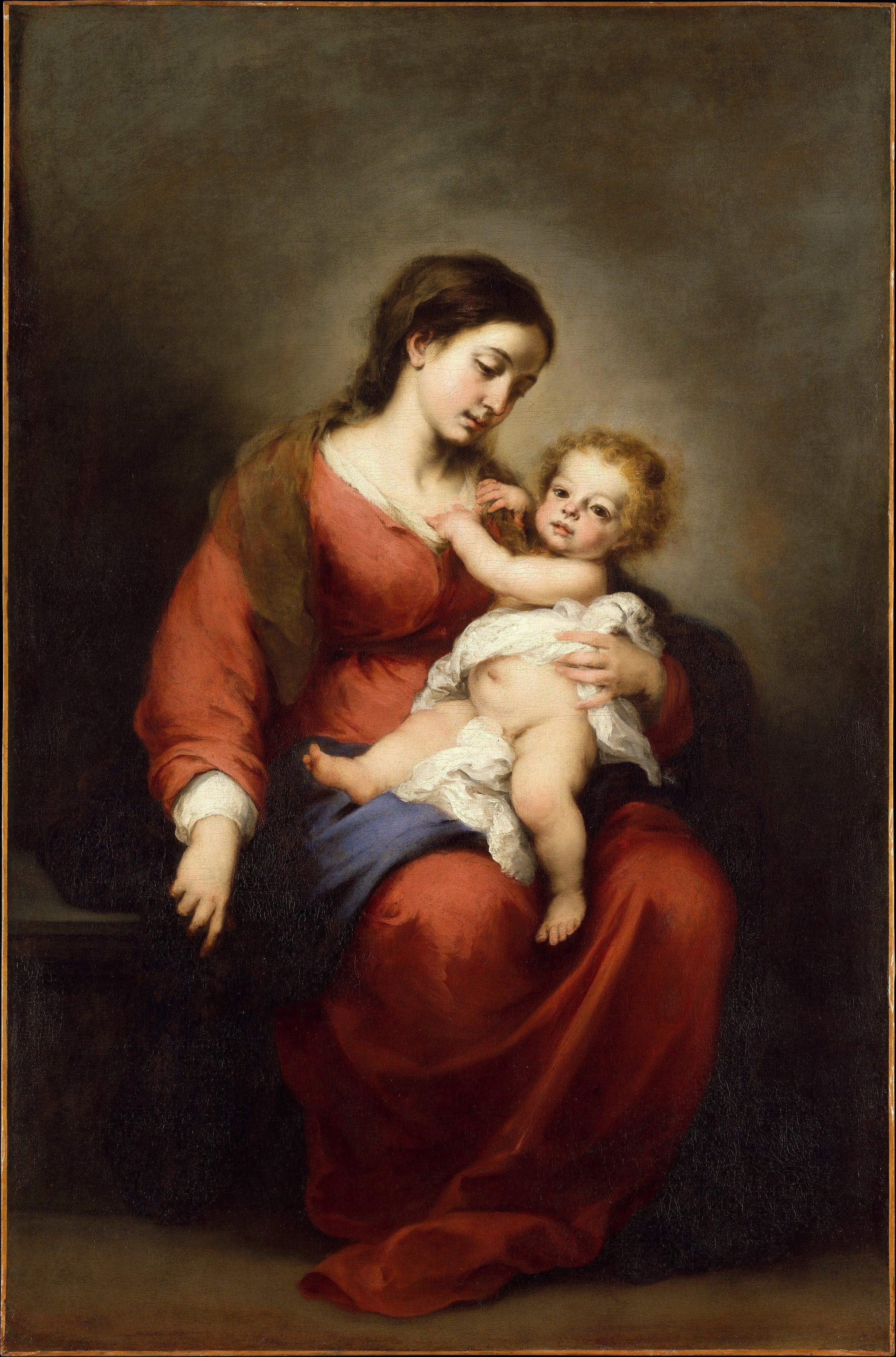
The painting shows the Virgin Mary seated and holding the Christ Child on her lap in a scene of focused, affectionate intimacy. The maternal figure occupies the center of the composition: she inclines her head toward the child and encircles him with her arms, while he lies across her lap and reaches one hand toward her face and neck. A white cloth partially covers the child’s body, contrasting with the Virgin’s red tunic, the brown mantle falling over her shoulders, and the blue cloth spread beneath the figures. The dark background and earth-toned floor envelop the group in warm stillness, with no secondary elements to distract from their encounter.
The Virgin and Child is one of the central subjects of Christian imagery and Marian devotion. The scene brings together two inseparable dimensions: the sacred identity of the Christ Child and the human closeness of the relationship between mother and son. Rather than presenting a distant or ceremonial vision, the work brings the episode closer to the viewer through physical contact, the inclination of the figures’ heads, and the naturalness of the child’s gesture. This combination of tenderness and reverence explains the theme’s enduring presence in the Western tradition: the image invites viewers to contemplate the divine through the familiar experience of care, protection, and family bonds.
Gestures convey much of the visual meaning. The child’s arm reaching for the Virgin’s face creates a line of contact across the center of the scene, while the mother’s hands offer protection and stability in response. The brighter light around the faces focuses attention on the spiritual and emotional dimension of the encounter, without the need to separate the figures with clearly defined halos. The white cloth serves as a luminous contrast and an element of decorum; against it, the red, blue, and brown fabrics add richness and depth. The composition can thus be read as an image of devotional tenderness, in which the humanity of the gestures brings the sacred nature of its protagonists close to the viewer.
Formally, the composition is arranged along a gentle diagonal that begins at the Virgin’s bowed head, continues down the child’s body, and descends toward the fabrics gathered in the lower part of the painting. This arrangement avoids frontal rigidity and creates a serene, almost circular movement around the exchange of glances and gestures. The dark background serves as a visual foil, making the faces, the child’s skin, and the light-colored folds stand out, while the carmine red concentrates the chromatic weight in the lower center. The warm lighting models the forms with soft transitions and brings the two figures together in a compact focal point, so that the space seems to be built around them rather than opening onto an external scene.
The work is consistent with a widely recognized aspect of Bartolomé Esteban Murillo’s art: intimate devotional painting, soft modeling, warm light, enveloping color, and particular attention to the tenderness of human relationships. In this reading, the painting’s power does not depend on a complex narrative, but on how it turns a familiar sacred subject into a tangible presence. Notice the path from the Virgin’s head to the Child’s outstretched arm and from there to the white cloth: this sequence brings together affection, protection, and luminosity, while the dark background preserves an atmosphere of contemplation around them both.
Have questions about our oil painting reproductions? See our frequently asked questions.