

Description
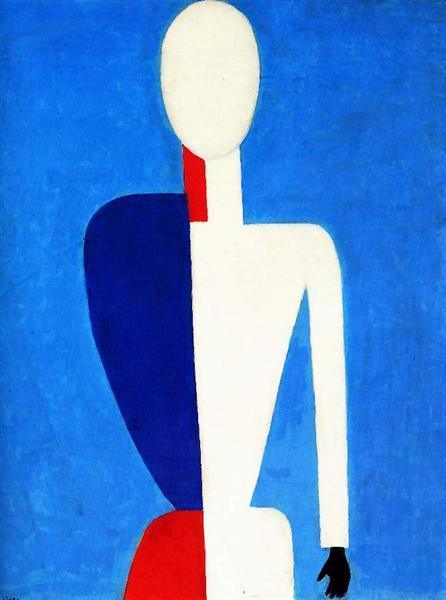
The painting Torso depicts a stylized, frontal, elongated human figure occupying the center of the composition from the top edge down to the lower edge. Its oval head lacks facial features, while the ivory-white body is articulated through a narrow torso, a rounded lower extension and deliberately elongated limbs. One arm descends along the right side and ends in a small black shape resembling a hand or glove. Behind the body spreads a large swath of dark blue, while red blocks appear next to the neck and in the lower-left area. Everything rests on a background of bright, textured blues that turn the figure into an isolated, silent and easily recognizable presence.
There is no specific historical, religious or mythological narrative here. The work belongs to the domain of the simplified human figure and figurative abstraction: the body is not presented as the portrait of a particular person, but as an anonymous structure subjected to a rigorous chromatic construction. The title focuses attention on the central area of the body, although the composition also includes head and limbs. That choice shifts interest from individual identity to physical presence, verticality and the relationship between the different parts of the silhouette.
The absence of facial features removes any psychological gesture and makes the figure function almost like a sign. The white of the body acquires a striking presence against the intense blue of the surrounding space, while the red areas introduce warm interruptions that tense the continuity of the form. The dark blue block can be read as a shadow, a secondary silhouette or a spatial counterpoint behind the torso; in any of these readings, it reinforces the sense that the body is constructed in layers. The black and red shapes act as accents of fragmentation, moving the figure away from a naturalistic anatomical representation and closer to an emblematic image.
The composition is organized vertically with an asymmetrical balance. The central figure functions as an axis, but the large dark mass on the left and the extension of the right arm prevent the image from being static or merely symmetrical. The blue background, worked through variations of tone and texture, provides atmospheric depth without depicting a recognizable place. Against that surface, the white planes read with clarity and the red, dark blue and black colors establish a rhythm of contrasts. The eye first scans the faceless head, descends down the torso and continues toward the lower part, following the extended line of the arm. Thus, the work combines frontality with contained movement.
In general, Torso can be linked to Kazimir Malevich’s interest in the radical simplification of form, the autonomy of color and compositions with strong visual impact. In this work those devices do not completely abandon the figure but rather reduce it to an almost architectural presence: a recognizable body transformed into planes, blocks and extended lines. Note how the white torso retains a human reference while the blue background, the dark shadow and the red accents break it apart. The power of the work arises precisely from that tension between body and abstraction, between a figure that seems present and a form that resists revealing an identity.
Do you have questions about our oil-painting reproductions? See our frequently asked questions.