

Description
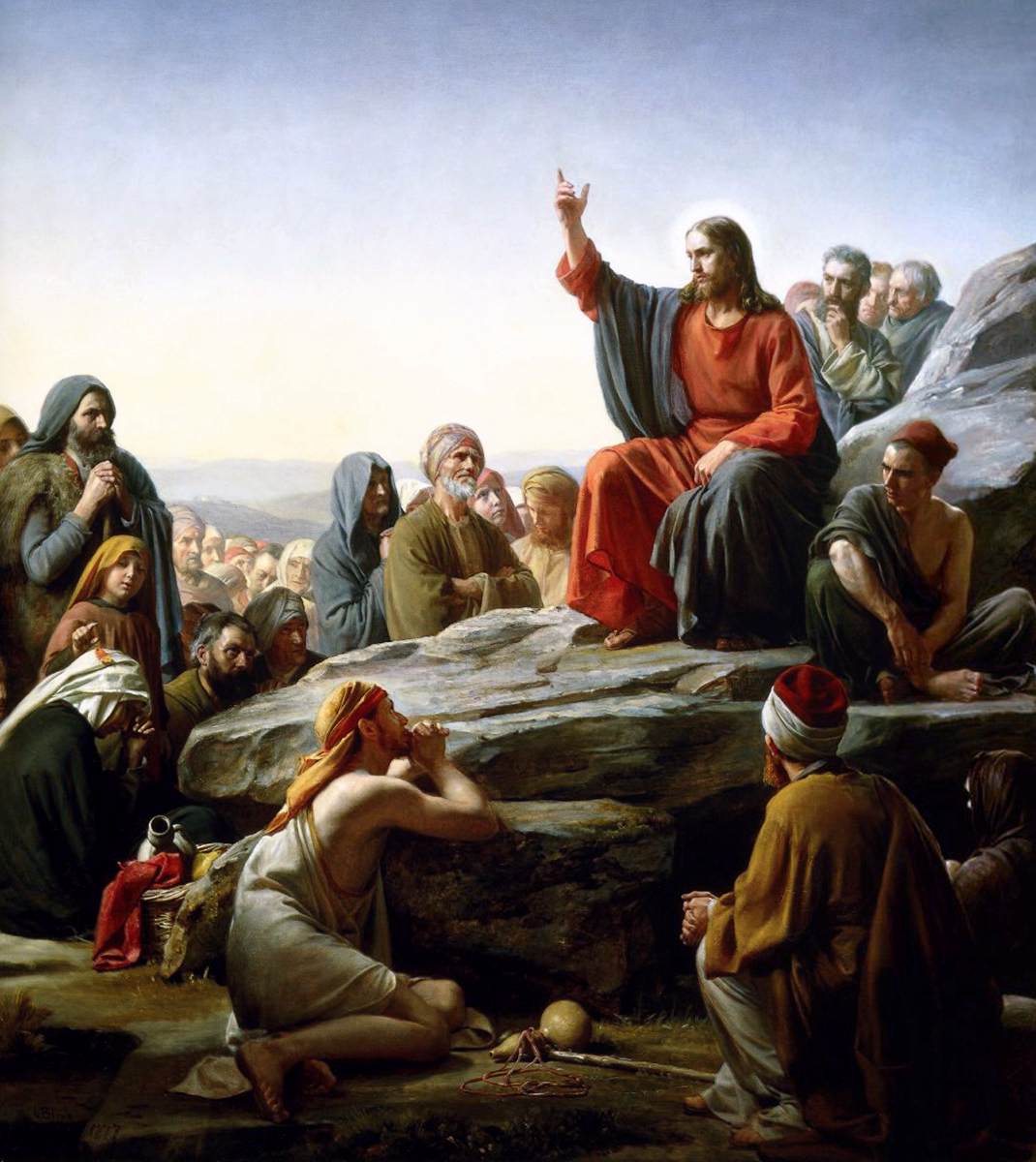
The painting shows Christ preaching to a crowd gathered among rocks and open hills. Seated on a large rock formation, he occupies the upper center of the composition and raises his right hand in a clear gesture of teaching. His red tunic and dark blue mantle immediately distinguish him against the earthy tones of the landscape. Around him, men and women of different ages are gathered, dressed in tunics, veils, mantles, and head coverings. In the foreground, two kneeling figures turn toward the scene; beside them are a basket covered with a red cloth, a dark vessel, and several objects arranged on the rocky ground. The luminous sky and distant hills extend the space beyond the gathered crowd.
The episode depicted is the Sermon on the Mount, one of the central passages in Jesus’s teaching in the Gospel of Matthew. According to the account, Jesus speaks to his disciples and a crowd from an elevated place, turning the natural landscape into a place of gathering and listening. The Beatitudes open this series of teachings, which also addresses ethical and spiritual principles such as love for one’s neighbor and prayer. The painting does not illustrate a specific saying; instead, it visually distills the essential scene: a teacher raised above the crowd, an attentive community, and an open setting that receives his words.
Christ’s position on the rock serves as a sign of authority and stability. His raised arm establishes a line of communication with the listeners, while the gazes and bodies of the crowd form a network of attention that draws the focus back to him. The kneeling figures in the foreground add a participatory dimension: viewers approach the scene at the same level as those listening. The basket, cloth, and vessel enrich the material presence of the gathering without distracting from its spiritual core. The rugged, barren rocky landscape underscores the public and solemn character of the teaching, far removed from a domestic or ceremonial interior.
Formally, Carl Bloch organizes the work around a strong contrast between the density of the figures and the luminous expanse of sky. The large horizontal rock acts as a visual platform and separates the main group from the horizon, while the crags on the right create depth and frame the central figure. The diagonals formed by the bodies, garments, and profiles lead the eye from the foreground to Christ. The red of his tunic draws the viewer’s attention, while the dark blue of his mantle sets up a counterpoint to the grays, ochres, and muted greens of the surrounding garments. The light on the horizon softens the distance, while the shadows on the ground and in the folds add volume and drama.
The work reflects the narrative realism for which Carl Bloch is known in his religious paintings: expressive figures, legible gestures, and lighting used to organize the scene and heighten its devotional intensity. The crowd does not appear as a uniform mass, but as a succession of faces, postures, and reactions that makes the collective dimension of the episode visible. It is worth noting how the color contrast distinguishes Christ without isolating him from those around him: his authority stems as much from his elevated position as from his visual connection with the listeners. In this way, the landscape, light, and harmonious arrangement turn a religious teaching into a shared experience of attentive listening, centered on the teacher’s raised hand.
Have questions about our oil painting reproductions? See our frequently asked questions.