

Description
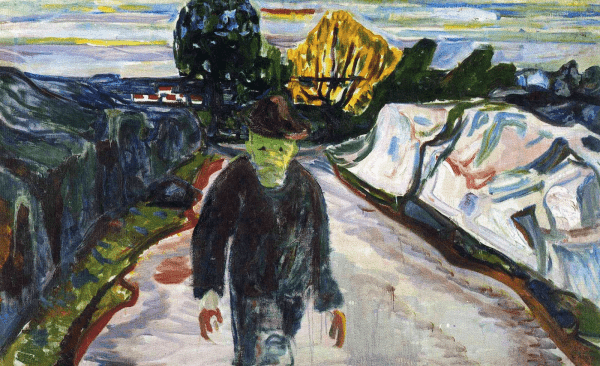
The painting shows a solitary figure, identified by the title as The Murderer, standing still or moving along a path that climbs between mountains. The figure occupies the lower center of the composition and wears a loose, dark garment that stands in marked contrast to the bright landscape opening up behind them. Their hands hang at either side of the body, while the face, rendered in greenish tones with simplified features, introduces a sense of unease. A deep, layered rock face rises on the left; on the right, a large mountain mass dominates in shades of white, blue, gray, and pink. In the distance are slopes, vegetation, and small buildings with reddish roofs, while the sky stretches out in horizontal bands.
The work does not depict a canonical narrative episode or an explicit scene of violence. Its story centers on the protagonist’s isolation and the path that places them within a remote landscape. The path can be understood as a physical route, but also as a psychological passage: it leads the eye toward the mountains and turns the natural surroundings into a setting of contained tension. The figure is neither part of a community nor accompanied by other people; they remain alone before an open, cold, monumental expanse. In this sense, The Murderer approaches a genre scene charged with unease, in which the title transforms an everyday presence into a threatening identity.
The contrast between the dark coat and the brightness of the snow or slopes intensifies the figure’s separation from the world around him. The greenish face adds an almost spectral quality and reinforces a reading of isolation and psychological estrangement. The light-colored path serves as an axis of passage, destiny, or inner journey, while the rocks on either side channel it like a corridor. Above the figure, the golden-yellow foliage introduces an unexpected warm focal point: its chromatic intensity can be read as a sign of vitality, but also as a disturbance within the cool palette. The tension arises precisely from the coexistence of natural beauty, solitude, and latent threat.
The composition is vertical and carefully organized around the central axis of the path. Its edges lead the eye from the foreground to the horizon, passing by the protagonist’s body. The rocky wall on the left adds weight, darkness, and depth; the light-colored mountain on the right balances the scene with a more open, luminous form. Masses of trees and shrubs create an irregular frame that contains the space, while bands of sky introduce a horizontal rhythm that contrasts with the path’s ascent. The colors do not aim for a neutral topographical description: dark greens, grayish blues, blacks, yellows, and reddish pinks shape an emotional experience. Simplified forms and visible brushstrokes make the landscape seem to vibrate around the figure.
In the context of Edvard Munch’s work, the painting is consistent with an expressive conception of landscape, based on unnaturalistic color, intense contrasts, and a composition designed to convey psychological tension rather than objective description. Here, nature is more than a simple backdrop: the rocks, mountain, foliage, and sky all contribute to the construction of the emotional state. Note how the path keeps the depth open while the figure remains motionless and frontal within the visual axis. This contradiction between forward movement and stillness sums up the power of the work: the murderer seems trapped between a landscape that invites him to continue and a chromatically heightened environment that turns every step into a scene of unease.
Have questions about our oil painting reproductions? See our frequently asked questions.