

Description
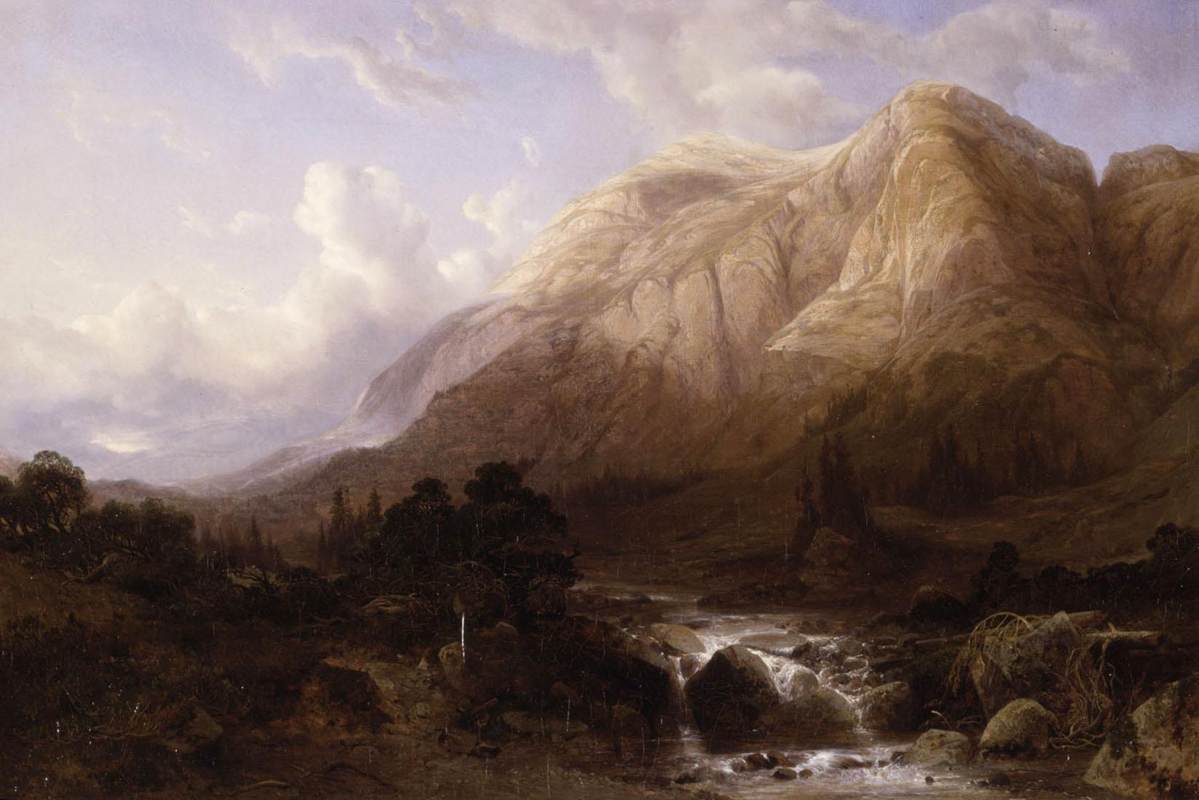
The painting shows a mountainous landscape dominated by a great rocky peak, whose slopes descend toward a wooded valley. At the center, a torrent winds among rocks, rapids, and small waterfalls before reaching the foreground. Boulders and dark vegetation frame the watercourse, while a line of trees stretches along the foot of the mountain. The clear sky, covered with white and grayish clouds, fills the upper part of the painting and balances the density of the terrain. The eye thus travels through a continuous space: it starts at the nearby rocks, follows the movement of the water, and finally rises toward the peak.
As an alpine landscape, the work presents no specific historical, religious, or mythological narrative. Its subject belongs to a tradition that turns mountainous nature into a setting of grandeur, depth, and contemplation. The relationship between mountain, forest, sky, and water shapes an experience of scale: the torrent brings the landscape closer to the viewer, while the peak expands the scene into a majestic dimension. Nature is not merely a backdrop but the true protagonist of the composition, brought together through shifts in elevation, distance, and atmosphere.
The mountain embodies permanence and the force of nature, set against the torrent’s ceaseless movement. The water creates a dynamic axis that connects the distant valley with the rocks in the foreground, making the landscape seem to extend toward the viewer. The dark forest and thickets act as a visual threshold: they shield the intimacy of the foreground while also heightening the vastness of the illuminated slopes. The voluminous clouds and changing light reinforce a Romantic sensibility toward the sublime, founded on the contrast between the near and the immense, between the mountain’s stillness and the water’s energy.
The composition is built through a succession of planes that clearly guides the viewer’s attention. The rocks in the foreground add weight and visual texture; the torrent introduces a sinuous line through the center; and the slopes lead the eye toward the dominant mass of the summit. The palette of deep greens, browns, ochres, purplish grays, and cloudy whites creates an alternation between shadowy areas and more open surfaces. This tonal contrast creates depth without disrupting the overall serenity. The mountain occupies an elevated and powerful position, but the water keeps the scene from becoming static: its rhythm of rapids and waterfalls keeps the eye moving.
In this respect, Alexandre Calame is associated with Swiss Romantic landscape painting and a dramatic vision of Alpine environments, created through wooded masses, changing atmospheres, and contrasts of light. Mountain Landscape with a Torrent captures this sensibility by turning a natural feature into a pathway to the grandeur of the landscape. It is worth observing how the stream does not compete with the mountain, but instead reveals it gradually: first as movement among the rocks, then as a spatial direction, and finally as a counterpoint to the permanence of the summit. The work’s contemplative power lies in this relationship between water, forest, cloud, and stone.
Have questions about our oil painting reproductions? See our frequently asked questions.