

Description
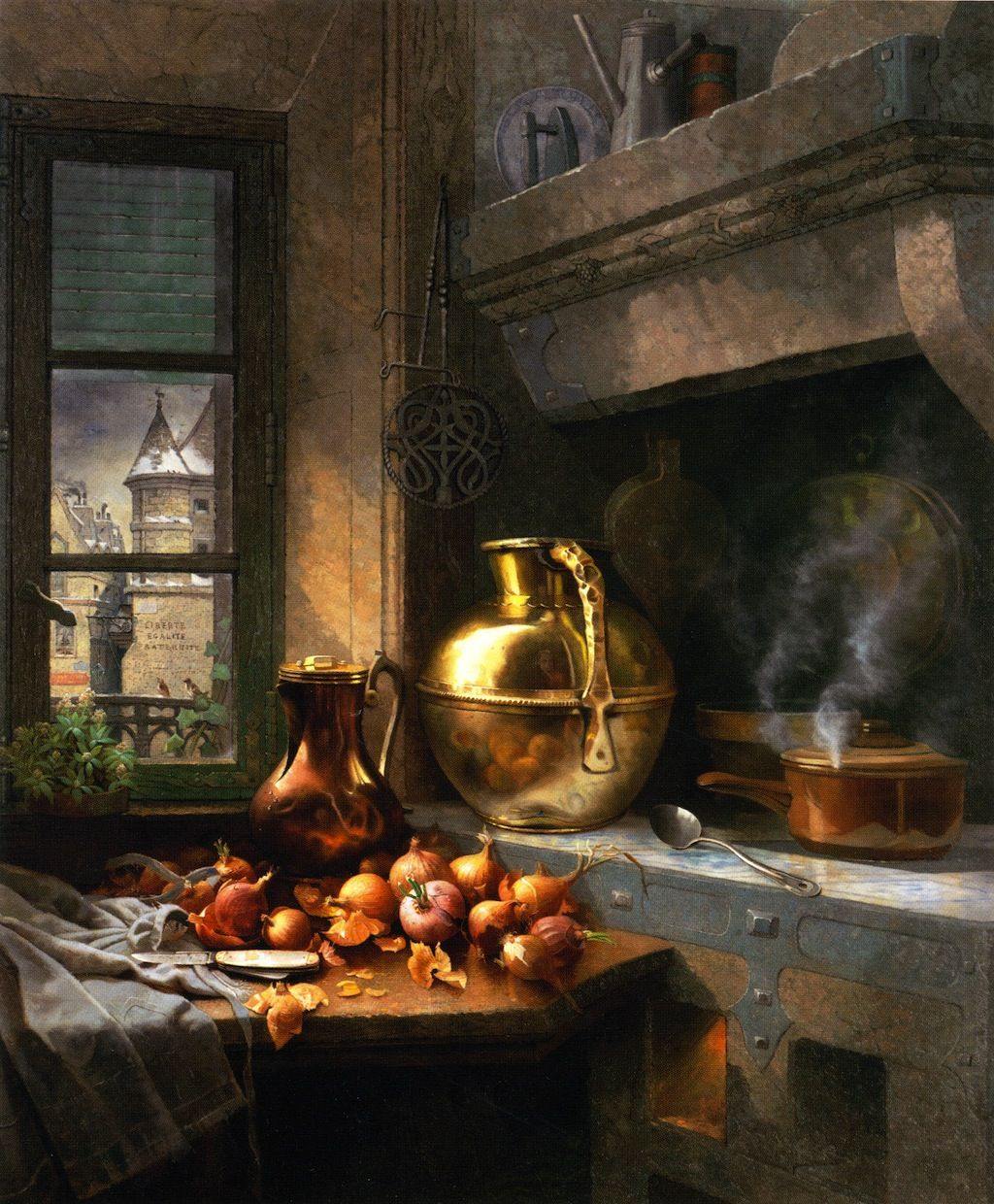
The painting depicts a busy, focused kitchen corner arranged around a wooden table piled with whole onions, cut onions and onions still wrapped in their skins. At the center stand a copper pitcher and a large, golden metal vessel, their surfaces standing out against the dark tones of the interior. On the right, a pot or saucepan sends up a column of white steam, while a spoon and a small bowl rest on the work surface. A gray cloth, a partly concealed plate and loose onion skins complete the foreground. The window on the left opens the room onto urban buildings, a pointed tower and a plant resting on the sill.
The subject belongs to the genre of the interior still life and centers on an everyday scene of food preparation. There are no human figures or historical narrative to distract from the domestic space: activity is made visible through the ingredients, utensils, heat and steam. The kitchen appears as a place of work, storage and material togetherness, where the objects have such a tangible presence that they seem to extend the actions of whoever uses them. In this sense, Edwin Deakin’s work transforms a functional room into the main setting for a thoughtful observation of daily life.
The onions account for much of the composition’s visual meaning. Their abundance, varying stages and shed skins evoke the immediate work of preparation and the laborious nature of the kitchen, without the need for an explicit allegory. The steam heightens the sense of the present moment: something is being heated or cooked, and the still life seems to continue beyond the instant depicted. In contrast to this intimacy, the window introduces an exterior, urban dimension. The contrast between the vessels, the aged walls and the distant buildings brings together domestic labor and the open world beyond the room.
The formal structure is based on a dense, vertical composition. The rounded mass of the onions establishes a low, expansive rhythm, while the pitcher, the large central vessel and the column of steam introduce upward axes. The window serves as a source of lateral light on the left; from there, the eye passes across the copper, ochres and grays to reach the more shadowed cooking area. The diagonal shelf at the top organizes the depth and leads the eye to the right, where the masonry and pot reinforce a sense of weight and permanence. The metallic reflections act as small flashes of light within a palette dominated by browns, charcoal, cream and muted green.
Without relying on an external stylistic characterization, Kitchen Corner finds its strength in the observation of surfaces and in the transformation of a domestic space into an atmospheric scene. The rusticity of the wall, the accumulation of vessels, and the proximity of the food make the viewer perceive the kitchen as a lived-in place, not merely a backdrop. It is worth noting how the onions lead the eye from the foreground toward the copper, and how the steam forms a bridge between still matter and culinary activity. Thus, the interior and the city outside are united by the same tension: the permanence of objects set against the silent movement of everyday life.
Have questions about our oil painting reproductions? See our frequently asked questions.