

Description
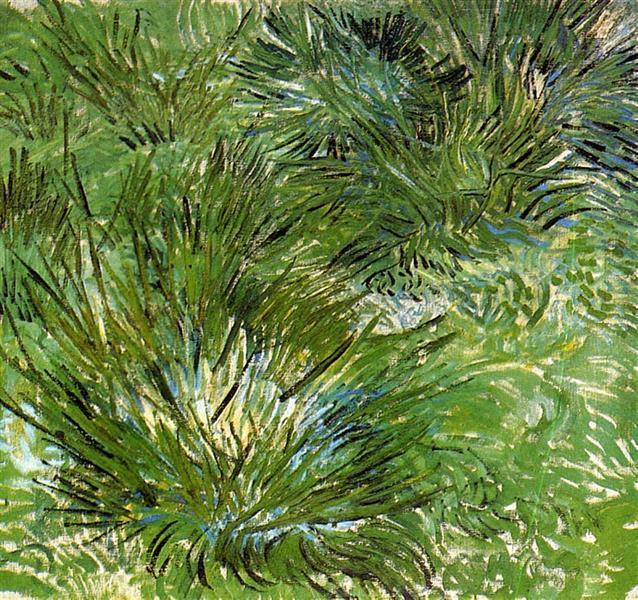
The painting shows several tufts of grass and long blades fanning out within a very close crop. The vegetation occupies almost the entire surface: some leaves emerge from the lower-left area, others arch toward the top, while a finer cluster extends to the right. There is no horizon, figures or architecture to distract from the main motif. The result is a concentrated vision of nature, where the vegetal mass becomes the true spatial subject of the work.
As a botanical landscape, Tufts of Grass does not rely on a narrative scene but on the intense observation of a fragment of the natural world. Vincent van Gogh treats the vegetation as an autonomous, expressive motif capable of sustaining the entire composition on its own. The close framing transforms humble plants into a pictorial subject of great presence. The landscape ceases to function as background and becomes a direct experience of density, growth and movement.
The concentration of overlapping blades directs the eye to the material and organic strength of the vegetation. The curved and diagonal forms suggest continuous growth, as if each tuft responded to the impulse of the others and kept the surface in motion. Contrasts among greens, blues, pale yellows and dark strokes enrich the overall reading: the grass does not appear as a uniform mass but as a living weave of directions, highlights and shadows. The chromatic variety intensifies the sense of vitality without turning the motif into an anecdotal scene.
Formally, the work is constructed through dense overlays and arched lines that create an almost radial rhythm. The broader leaves, located in the foreground, establish diagonals that guide the eye from the lower edge toward the center and the upper area. Between them, the light bluish brushstrokes fragment the green background and produce a short, compressed sense of depth characteristic of a detail observed very closely. The black and dark strokes act as visual pauses: they separate the leaves, emphasize their contours, and intensify changes of direction. The visible brushwork makes the surface seem to vibrate, so that the eye travels across the painting rather than fixating on a single point.
The treatment of nature aligns with a hallmark of Vincent van Gogh: energetic brushwork, expressive colour, and intense attention to the texture and rhythm of vegetal forms. Here that sensibility transforms a clump of grass into an almost abstract composition, sustained by diagonals, curves and luminous contrasts. It is worth noting how the title derives its power not from identifying a specific species, but from the multiplication of groups that fill the visual field. The work makes the energy of the landscape visible through the very materiality of the paint.
Do you have questions about our oil-painting reproductions? See our frequently asked questions.