

Description
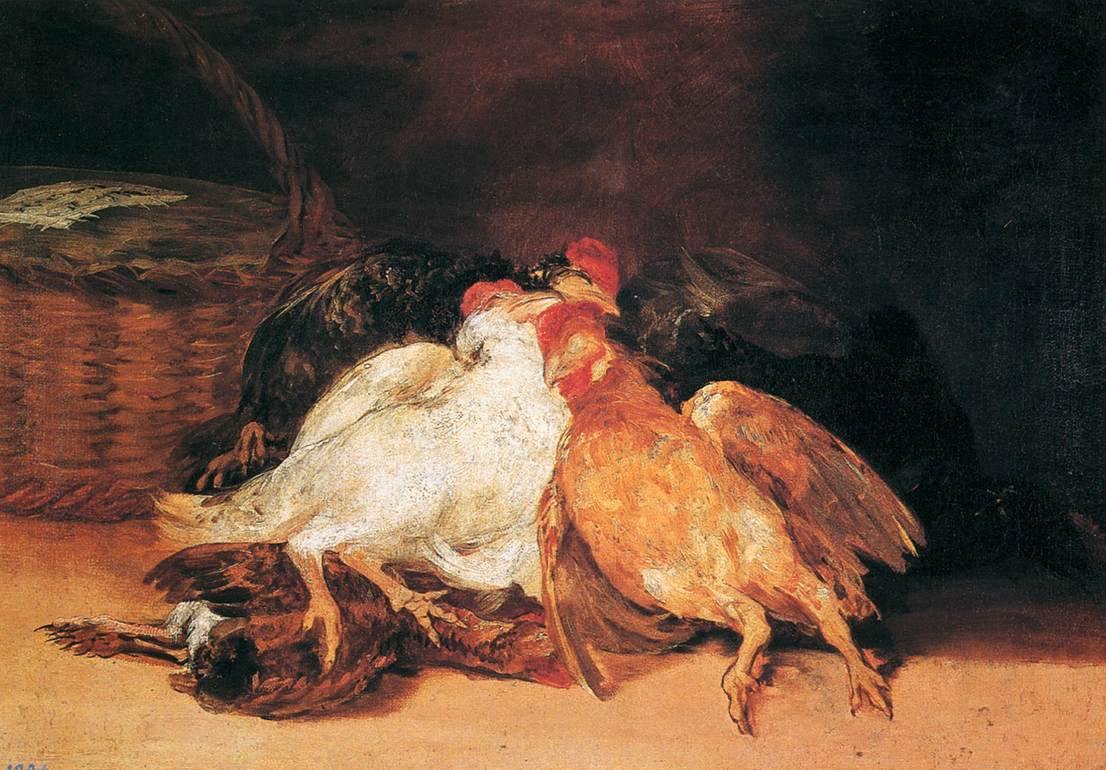
The painting shows a compact group of dead birds arranged on an earthy surface. At the center, a bird with white or cream plumage lies horizontally, drawing the eye to the left, while another, large and orange, coppery and reddish, occupies the right foreground. Dark, brown and reddish birds overlap around them, some crouched or lying down, forming a mass of bodies, wings and feathers. The ochre ground catches their shadows and brings them visually closer to the viewer. Above this group, the background closes in with black, reddish-brown and coppery tones, without opening onto a recognizable landscape. Francisco Goya’s scene makes its impact through its concentration and the physical presence of the animals.
In subject and arrangement, the work belongs to the genre of still life, which brings together objects, food, animals and other motionless elements as subjects for contemplation. The depiction of dead animals is a traditional still-life motif and can be associated with hunting scenes or the display of game, without the need to construct a specific human anecdote. There are no hunters here, nor any explicit narrative episode: the event seems to have been reduced to its material consequences. The group of birds is presented on the ground as a silent accumulation, and this stillness transforms an everyday subject into a scene of profound gravity.
The stillness of the bodies introduces a visual reflection on the fragility and transience of animal life. The pile causes each bird to lose some of its autonomy while retaining its individuality through the color and texture of its plumage. Whites, copper tones, reddish hues, and blacks create material variety within a scene dominated by stillness. The bodies’ proximity to the ground reinforces a sense of weight, dejection, and vulnerability. The dark background also takes on an expressive role: it focuses attention on the illuminated birds and makes their forms almost palpable. The painting needs no added symbols; the substance of the feathers and the evidence of silence sustain its interpretation.
Formally, the composition is arranged as a compact horizontal band, with diagonals created by the outstretched body of the light-colored bird and the tilt of the orange bird in the foreground. This structure leads the eye from the center-left toward the right, then to the birds partially concealed in the background. The overlapping forms create depth without relying on open space: volume arises from the bodies’ proximity, the crossed wings, and the shadows beneath them. The contrast between the nearly black background and the light plumage establishes the main focal points, while the ochre tones of the ground serve as a heavy base that stabilizes the scene. The brushstrokes and shifts in color make the irregularity of the feathers visible, so the stillness does not amount to rigidity but instead conveys an intense tactile density.
Rather than relying on an extended narrative, Still Life with Dead Birds builds its strength from materiality, contrast, and silence. The attribution to Francisco Goya places the painting within a sensibility capable of turning a direct subject into a somber visual experience, although here the reading should begin with what the surface offers: clustered bodies, light cut against darkness, and earth that receives their shadows. It is worth observing how the pale bird structures the composition and how the orange specimen in the foreground introduces a warm, weighty counterpoint. Between them, the dark birds thicken the background and heighten the sense of accumulation. The subject, colors, and spatial construction thus converge in an image in which the still life becomes a meditation on the weight and fragility of life.
Have questions about our oil painting reproductions? See our frequently asked questions.