

Description
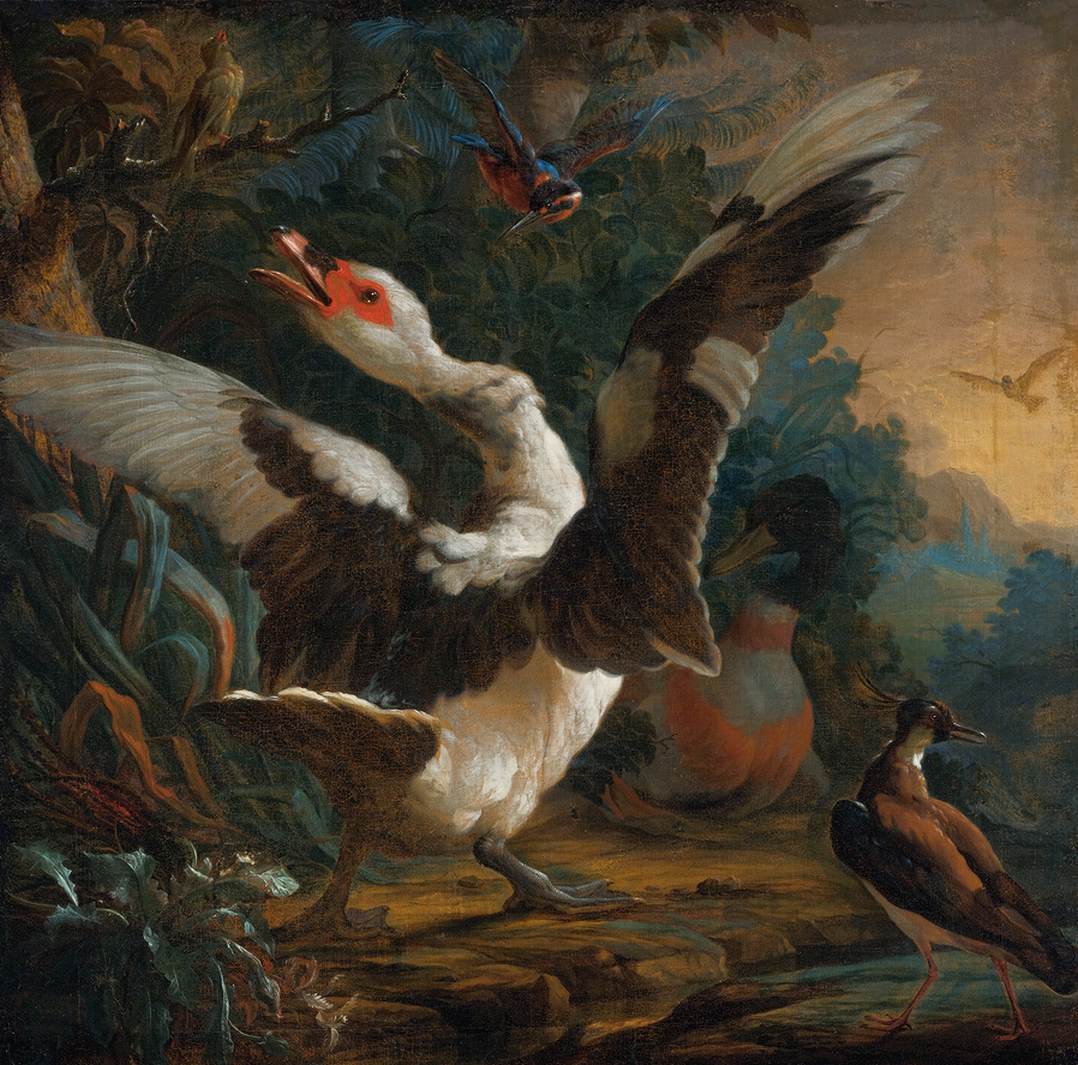
The painting Birds in a Landscape, by Abraham Bisschop, depicts a gathering of birds among lush vegetation, rocks, and a shallow stretch of water. A large white bird with a reddish head, an open beak, and outstretched wings dominates the center of the composition. Other birds are arranged around it: one crosses the upper part of the scene in flight, another blends in among the branches, and several remain partly hidden in the foliage and foreground. On the right, a bird with dark brown plumage and reddish legs stands upright beside the water, balancing the expansive energy of the central bird. The landscape extends into a warm-toned background, where bluish forms of vegetation or distant elevations appear.
The work does not depict a specific narrative episode; rather, it is composed as a nature scene observed at a moment of intense activity. Its interest lies in bringing together different positions and behaviors within a single habitat: flight, rest, alertness, and concealment. This variety makes the landscape more than a decorative backdrop: it is the space that organizes the birds’ coexistence and creates continuity between the visible areas and those suggested among the leaves and branches. In this respect, the painting belongs to a tradition of naturalistic representation in which attention to the animal world is combined with a richly immersive scenic composition.
The large central bird serves as the focal point of visual energy. Its outstretched wings and slightly open beak create a sense of immediate action, while the other birds extend that impression across the different planes of the scene. The animals partially concealed by the vegetation add depth and suggest an active natural world that extends beyond the central area. The water, rocks, and leaves form a shared habitat, closely connecting the figures with their surroundings. The contrast between the dominant bird’s pale plumage, the green and brown shadows of the foliage, and the reddish accents on several birds reinforces a sense of vitality and natural tension.
The dense, vertical composition draws the eye to the center but avoids rigidity through a network of diagonals: the outstretched wings, the bird in flight above, the slanting branches, and the irregular arrangement of the birds lead the eye from one point to another. The vegetation acts both as a frame along the sides and as a veil, alternating areas of concealment with openings onto the sky and horizon. At the bottom, the transition between land, rocks, and water provides the composition with a tactile, spatial foundation. The palette of dark greens, ochres, browns, ivory whites, and grayish blues creates a strong contrast between the shadowy foreground and the luminous background, making the white bird stand out with particular intensity.
In Abraham Bisschop’s work, his interest in birds is expressed here through a combination of close observation of animals and theatrical composition. The scene unfolds like a moment suspended in time, although every element suggests movement: the beating of wings, the alertness of the central bird, the flight crossing the upper part of the scene, and the silent presence of the bird beside the water. Notice how the landscape both contains and releases the figures: leaves frame their bodies, while the warm background opens onto greater depth. The result is an image of exuberant nature in which the birds’ dynamism and the density of their surroundings form an inseparable visual unity.
Have questions about our oil painting reproductions? See our frequently asked questions.