

Description
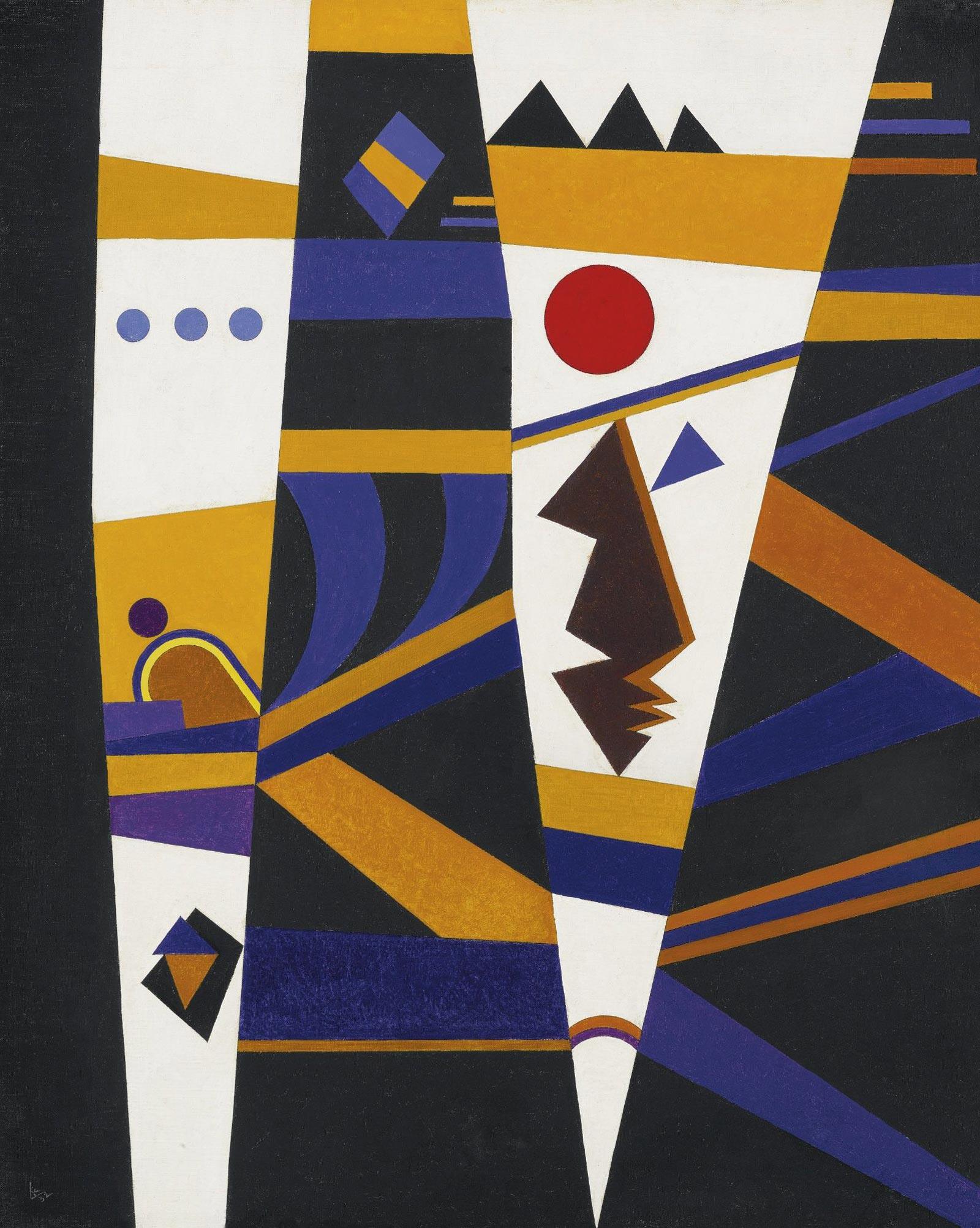
The painting presents a vertical-format geometric abstract composition built from large black and white fields that sustain an intense network of bands, blocks and colored figures. A red circle stands out in the upper right area, while three blue circles align in the upper left sector. Black triangles, segmented lozenges, small arches and curved shapes are distributed among blue, ochre, orange and purple diagonals. In the center right appears an angular brown figure, surrounded by white planes and color accents. The whole does not depict a narrative scene or a recognizable object: its subject is the dynamic relationship between forms, contrasts and directions.
“Binding” can be read as a conceptual name for this structure of linked and assembled elements. Rather than literally showing a book or a cover, the work arranges its components as if each band, circle and plane were part of a larger visual construction. This approach places the piece within geometric abstraction and brings it close to the artistic language of Wassily Kandinsky, in which lines, colors and autonomous shapes can articulate a composition without relying on figurative representation. The reading thus shifts from narrative to the experience of ordering and traversing pictorial space.
The black and white fields act as an irregular grid of contrast: they separate the color areas and, at the same time, hold their tensions together. The red and blue circles function as points of emphasis within the composition, while the triangles, lozenges and short bands introduce pauses and rhythmic accents. The curved shapes in the central-left area and the arches at the bottom soften the abundance of diagonals, creating an alternation between impulse and repose. Rather than specific narrative symbols, these elements can be understood as units of a visual grammar in which each figure gains strength from its position and from its chromatic relationship to the others.
The spatial organization is asymmetrical and densely fragmented. The large black planes provide weight and visual depth, while the whites open intervals that allow overlapping or adjacent shapes to be distinguished. Long diagonals lead the eye from the center toward the right and lower edges, generating a sense of movement; the horizontal and vertical bands introduce a stabilizing counterpoint. Color operates through direct contrasts: red concentrates attention, blues traverse the surface like lines of continuity, and ochres, yellows, oranges and purples supply variations of temperature. The gaze advances in jumps, following circles, triangles, arches and abrupt changes of scale.
The work is consistent with Wassily Kandinsky’s abstract language: autonomous geometric forms, intense chromatic contrasts and a dynamic composition in which lines, circles and color planes organize the visual rhythm. In Binding, that logic turns the surface into an architecture of relationships, where each fragment seems to hold, separate or propel the others without losing its independence. Pay particular attention to how the black and white fields structure the path and how the diagonals lead toward the lower arches; there you realize that the title functions conceptually, as an image of connection between diverse parts within the same abstract order.
Do you have questions about our handmade oil-painting reproductions? See our frequently asked questions.