

Description
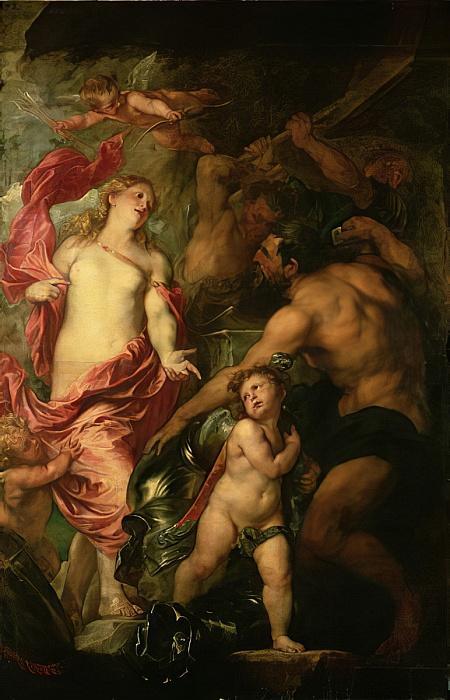
The painting shows Venus before Vulcan as she asks him for the armor of Aeneas. The scene is arranged as a densely populated, theatrical group: the female figure, half-naked and wrapped in reddish drapery, dominates the left side; a naked child occupies the central foreground, while a muscular man, seen from behind, leans in from the right. Red, pink, green and dark fabrics billow between them, and several secondary figures emerge from a shadowy background. Dark, gleaming forms associated with weaponry and Vulcan’s material craft gather in the lower part of the painting, while an elongated object rises diagonally toward the upper right.
The episode belongs to Roman mythology and is associated with the Aeneid. Venus, the mother of Aeneas, goes to Vulcan, god of fire and the forge, to ask him for the weapons intended for her son. The request brings together two dimensions of the story: a deity’s maternal protection and the hero’s material preparation for his destiny. Vulcan’s presence transforms the setting into a place of making, strength and transformation, though the scene is more than a workshop: it is also a divine apparition, charged with gestures, fabrics and human presences.
The iconography is structured around the contrast between Venus and Vulcan. The woman’s radiance and the richness of the fabrics introduce beauty, power and movement, while the artisan’s powerful back conveys physical energy and labor. The objects grouped in the foreground can be read as weapons or parts of an armor, and serve as the material focus of the request. Positioned between the protagonists, the child heightens the familial and heroic dimensions of the episode without needing to be identified as a specific attribute. Thus, Aeneas’s destiny is suggested through objects, bodies and spatial relationships.
The vertical composition concentrates the action along a diagonal running from Venus’s drapery and body toward Vulcan’s figure and the objects below. The child serves as an intermediate axis, stabilizing the composition, while the raised arms, flowing drapery, and oblique forms create a continuous sense of forward movement. Light is reserved for the bodies and the most pronounced folds, which stand out against a background of greens, browns, and blacks. This chiaroscuro does more than separate the planes: it directs the eye from Venus’s luminous presence to Vulcan’s sculptural strength and, finally, to the armor that gives the scene its meaning.
In Sir Anthony Van Dyck’s work, this Baroque language is evident in the theatricality of the composition, the monumental scale of the figures, and the tension between elegance and expressive intensity. The rich colors of the drapery soften the somberness of the background, while the luminous modeling of the bodies gives the scene an almost stage-like presence. The work transforms a mythological request into a spectacle of material and movement: Venus brings a divine, protective dimension, Vulcan the power of the forge, and Aeneas’s armor unites these forces in a promise of heroic action.
Have questions about our oil painting reproductions? See our frequently asked questions.