




Description
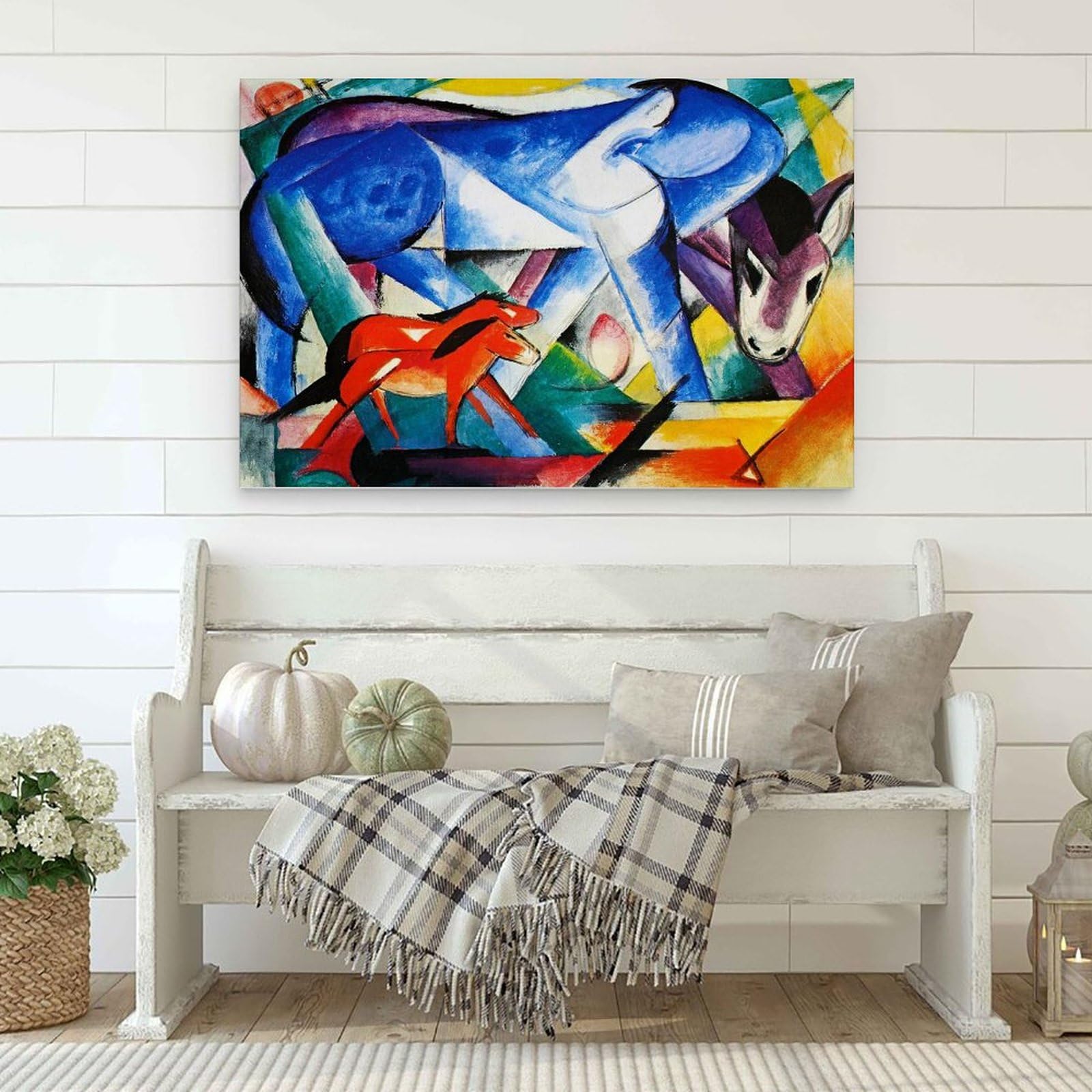
The painting shows a group of stylized animals gathered in a horizontal composition of great chromatic intensity. In the upper central band, a large blue animal arches its body and descends with its head inclined, as if concentrating the movement of the entire scene. In the foreground, a red fox advances among angular planes, while the elongated head of an equid emerges on the right side and directs its muzzle toward the center. There is no naturalistic landscape or a recognizable setting: the space is constructed with blocks of blue, green, yellow, red, white, black, violet and pink, which overlap like pieces of an imagined world.
The First Animals does not present an anecdotal story or a specific narrative episode. Its subject is the gathering of several creatures in a space of primordial appearance, where animal life is expressed through rhythm, color and structure. The title invites a poetic reading of that ensemble: “first” suggests an origin, an initial vitality or an elemental relationship with the world, rather than a literal historical sequence. The work thus sits within the field of modern painting that transforms the observation of nature into a symbolic and emotional experience. The animals do not function solely as identifiable species, but as presences that organize the energy of the picture plane.
The contrast between the figures allows each animal to be associated with a distinct visual quality. The dominant blue of the large upper body provides breadth and gravity, while the fox’s red concentrates attention on the lower area and establishes a warm focal point against the cold mass that precedes it. The equid, composed of violet, black and light planes, acts as a counterweight at the far right. The coexistence of these creatures turns the surface into a reflection on the diversity and the strength of the living.
Formally, the composition is organized around a large arched diagonal. The blue animal leads the eye from the left toward the center, while the fox introduces a visual descent to the lower part and the equid’s head returns the path to the right. Geometric planes fill the intervals between the figures and eliminate conventional depth, so that the space appears compressed onto the surface. Angular lines, abrupt changes of scale and the alternation of intense colors produce a staccato rhythm, almost musical. The result is dynamic without relying on explicit action: movement arises from the tension between bodily curves, diagonals and chromatic fields.
The work relates to a trait widely associated with Franz Marc: the expressive depiction of animals through intense colours and simplified forms that take on a symbolic dimension. Rather than rendering anatomy naturalistically, Franz Marc transforms the creatures into living structures that support the composition and direct its emotional pulse. Note how the large blue animal, the red fox and the equid do not compete with one another but form a system of weights, directions and chromatic temperatures. Therein lies the power of the painting: in turning a group of animals into a visual field where colour seems to give rise to form.
Do you have questions about our handmade oil-painting reproductions? See our frequently asked questions.