

Description
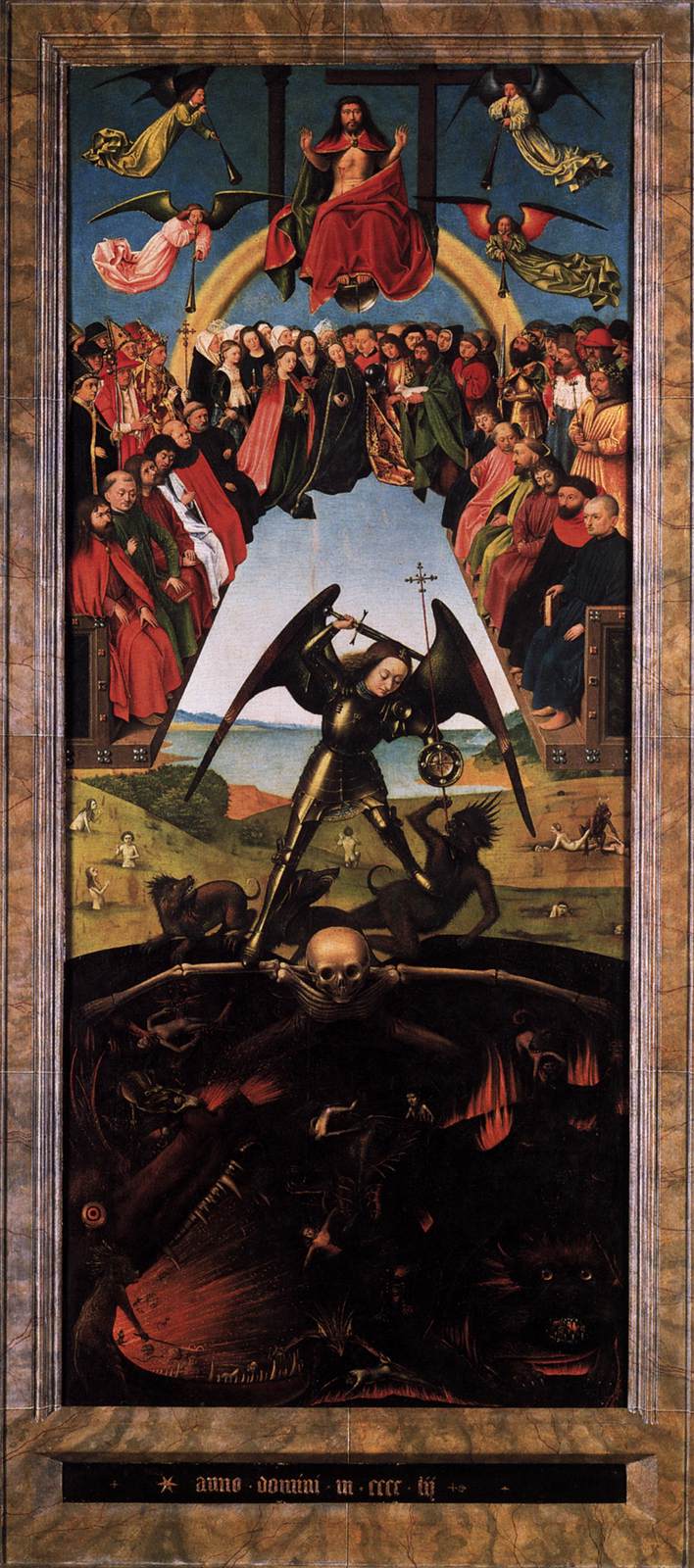
The painting presents the Last Judgment as a vertical composition of extraordinary narrative intensity. At the top, a male figure enthroned, with his torso bare, arms raised, and a red mantle, presides over the scene, surrounded by four winged figures. Below him, a crowd of men and women gathers, arranged on either side of a central axis and flanked by dark rows of seats or tiers. Farther down, an armored winged warrior confronts a black, dragon-like creature. The green, mountainous landscape leads the eye toward a huge human skull before opening onto a lower region populated by monsters, fire, and tormented figures.
The subject belongs to the heart of Christian eschatology: at the end of time, Christ appears as the judge of humanity, and each soul faces its ultimate fate. The upper zone centers on the celestial presence, while the crowd represents humanity summoned before the judgment. The contrast between the bluish and golden brightness above and the reddish darkness below visually conveys the division between salvation and damnation. Angels, weapons, demonic creatures, and fire are part of the traditional repertoire through which Christian art makes visible the conflict between the forces of heaven and evil.
The iconography is organized around powerful signs. The figure above, elevated over the whole composition, can be read as Christ the Judge; the winged figures act as a celestial court that reinforces his authority. The combat between the warrior and the monster introduces dynamic tension amid the crowd’s ceremonial gathering. The monumental skull interrupts the landscape as a reminder of death and the fragility of human existence. In the lower region, the mass of bodies, claws, wings, gaping mouths, and flashes of fire turns damnation into a physical and tumultuous experience, set against the order of the upper part.
Formally, the composition guides the eye along a central axis linking the throne, the armed figure, the skull, and the abyss. The golden bands and the groups of figures on either side create an almost architectural structure, while the small clusters of figures lend a varied rhythm of gestures, profiles, and garments in red, green, ochre, and black. Space unfolds in layers: sky, crowd, landscape, and the infernal realm. The color follows this descent, shifting from luminous blues and golds to deeper browns, blacks, and reds. The overall symmetry does not eliminate movement; it concentrates it in the central battle and the visual whirl of the lower section.
This work by Petrus Christus reveals the meticulous attention associated with 15th-century Netherlandish painting: individualized faces, varied attire, and numerous details turn the crowd into a sum of distinct presences. At the same time, the composition retains a descriptive clarity that allows the scene to be read from top to bottom without losing its complexity. It is worth observing how celestial order gradually gives way to agitation and darkness: The Last Judgment is presented not merely as a religious narrative, but as a visual architecture of ascent and fall, in which every color, figure, and empty space contributes to the division between salvation and damnation.
Have questions about our oil painting reproductions? See our frequently asked questions.