

Description
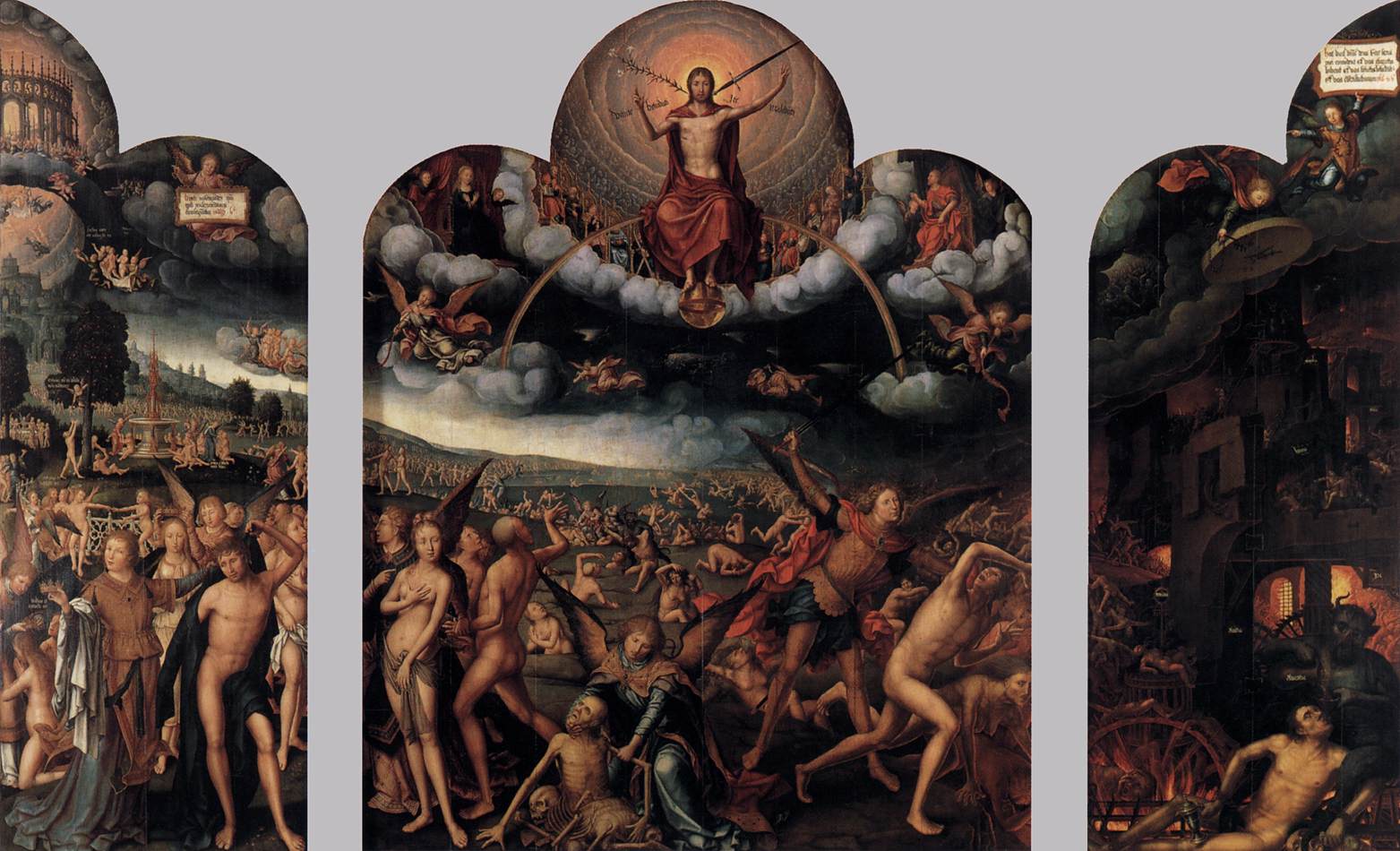
The painting depicts the Last Judgment as a monumental vision unfolding across three panels. At the center, a nude male figure sits on a golden sphere, arms outstretched and surrounded by a circular glow, clouds, and winged figures. Below him, a crowd of nude or semi-nude bodies presses together: some kneel, raise their arms, embrace, fall, or struggle. A skeleton lying in the lower area introduces a direct presence of death. On both sides, the narrative unfolds among landscapes, architecture, and groups of people. The left panel brings together trees, water, buildings, and figures in a more open space; the right descends into dark enclosures, flames, smoke, and scenes of torment. Cartouches, banners, and elongated objects enrich the surface with signs of a meticulous narrative.
In Christian tradition, the Last Judgment represents the eschatological moment when Christ judges humanity at the end of time. The composition contrasts celestial glory with the fate of the condemned, turning this opposition into a panoramic image. The central figure occupies the elevated axis of the whole as the eschatological judge, while the crowds make the collective dimension of the judgment visible. The clouds separate the upper realm from the earthly and infernal scenes, and the fire in the right panel gives visual form to damnation. The altarpiece thus presents a vision of resurrection, moral judgment, suffering, and eternal destiny without sacrificing the narrative complexity of its secondary episodes.
The iconography is built around recognizable contrasts. The radiance surrounding the central figure and the presence of winged beings evoke the celestial realm, while the sphere beneath his feet suggests symbolic dominion over the world. The nudity of the crowds places all human beings on equal footing before judgment and draws attention to their bodily vulnerability. The skeleton reinforces the connection between death, resurrection, and the mortal condition. At the far right, the enclosed structures, smoke, and flames form a space of confinement and punishment; opposite them, the landscape in the left panel heightens the contrast between openness and damnation. The agitated poses turn each body into a unit of drama within a collective scene.
Formally, the altarpiece directs the eye toward the center through a carefully tiered arrangement. The central panel, wider than the side wings, focuses attention on the monumental figure and the radiance, while the diagonals formed by arms, linear objects, bodies, and falling figures scatter the energy toward the lower area. The clouds act as a horizontal band dividing the golden brightness of the upper section from the browns, blacks, reds, and ochres that dominate the lower scenes. Scale establishes a decisive difference: the figure of the judge towers over the crowds, yet the abundance of figures returns the viewer to a sense of human chaos. Depth is constructed through overlapping forms, tiered architecture, and small episodes that call for close inspection.
In the context of Jean Bellegambe’s work, this painting belongs to the tradition of religious art in the old Low Countries, recognizable for its narrative density, descriptive precision, and the arrangement of numerous episodes within a single composition. The altarpiece does not depict the Judgment as an isolated scene, but as a complete universe in which heaven, humanity, and damnation are linked through clouds, bodies, buildings, and fire. The circular radiance at the center does not dispel the darkness of the world below; it orders it and makes it more intense. The work’s power lies in this tension between celestial order and the turmoil of the crowds, transforming an eschatological teaching into a visual experience on an all-encompassing scale.
Have questions about our oil painting reproductions? See our frequently asked questions.