

Description
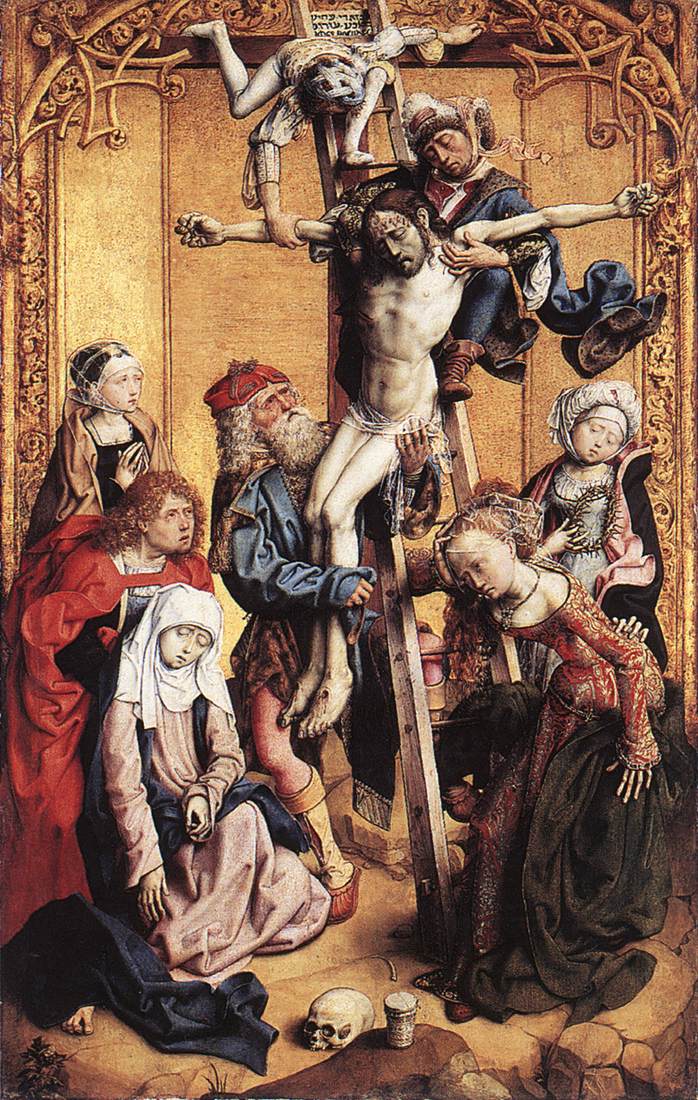
The Descent from the Cross shows the lifeless body of Christ as he is taken down from the cross, against a gold background. A man standing on a ladder leaning against the cross supports Christ’s torso beneath the arms, while another, perched high on the crossbeam, removes the nail from his hand; below, a bearded old man wearing a red cap receives Christ’s legs in his arms. On the left, Saint John, in a red mantle and with curly hair, accompanies the Virgin Mary, who has collapsed to her knees in the foreground, her eyes closed, beside another veiled holy woman. On the right, Mary Magdalene, wearing a luxurious red brocade gown, bends over in tears beside another woman in a white headdress. A skull and a small vessel lie on the stony ground, while a frame of gilded Gothic tracery encloses the scene above.
The Descent from the Cross is one of the final episodes of the Passion: after Christ’s death, Joseph of Arimathea and Nicodemus obtained permission to take his body down from the cross and bury him. According to traditional iconography, they are accompanied by the Virgin Mary, Saint John the Evangelist and the holy women. The Master of the Saint Bartholomew Altar, an anonymous painter active in Cologne in the late Gothic period, takes his name from an altarpiece dedicated to that saint and is one of the most refined artists of the Cologne school.
The skull at the foot of the cross alludes to Golgotha, the “place of the skull,” and, according to tradition, to Adam, whose sin is redeemed by Christ’s sacrifice. The Virgin Mary’s swoon expresses her participation in her Son’s suffering, while Mary Magdalene’s tears give voice to the grief of the faithful. The gold background sets the scene beyond ordinary time and space, as an image intended for devotional meditation.
The composition is organized around the cross and the ladder, which form vertical and diagonal axes against the golden background. Christ’s pale body, with his arms outstretched and torso sagging, creates a strong diagonal that guides the eye from above down to the figures on the ground. The figures are arranged almost like sculptures in a shallow relief, and the vivid reds, blues, and whites of their garments stand out against the gold and the ochre-toned ground. The brocade fabrics, veils, and jewels are rendered in minute detail.
The Master of the Saint Bartholomew Altarpiece’s style combines the precision of Flemish painting with a very personal elegance: stylized figures, refined gestures, and an ornamental richness reminiscent of goldsmithing. Our hand-painted oil reproduction on canvas preserves the gleam of the golden background, the intensity of the colors, and the detailed fabrics that characterize this work.
Have questions about our oil painting reproductions? See our frequently asked questions.