

Description
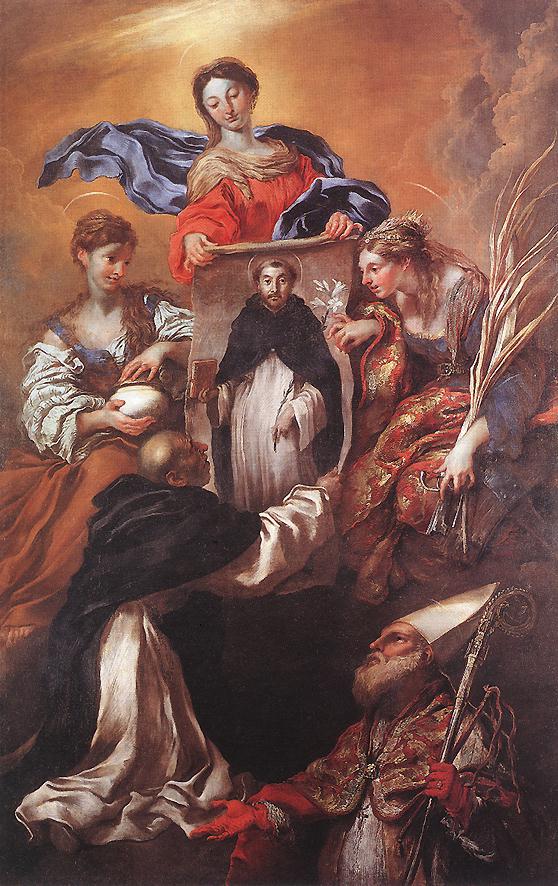
The painting depicts The Miracle of Soriano as a vertical, intense, and carefully tiered apparition. At the center, Saint Dominic, recognizable by his dark habit, light-colored garment, and circular halo, draws the scene’s gaze. Above him, the Virgin Mary appears in a red dress and blue mantle, holding a band outstretched between her hands, while two holy figures stand at the sides with their attributes: one holds a light-colored vessel, and the other a small bouquet of white flowers. In the foreground, a kneeling figure bows before the revelation, and a bearded man wearing a mitre and ceremonial vestments holds a staff. The branches along the right edge, the clouds, and the golden radiance complete the supernatural setting.
The subject comes from a Dominican tradition associated with Soriano in Calabria and a miraculous image of Saint Dominic. According to this devotional account, the Virgin intervened accompanied by holy figures to reveal or deliver the image of the founder of the Order of Preachers. The composition translates this narrative into an ascending structure: the celestial apparition occupies the upper area, Saint Dominic anchors the center, and the figures below represent the earthly and ecclesiastical reception of the miracle. Thus, the episode is presented not as an everyday scene but as a manifestation that rearranges the space and the hierarchies of the gaze.
The attributes help distinguish the different realms of vision. The halo of Saint Dominic and the luminous circle behind the upper figure establish a sacred axis that runs through the entire scene. The light-colored vessel and white flowers introduce hagiographic references and symbolize purity, while the mitre and staff of the figure at lower right bring ecclesiastical authority into the narrative. The band held by the Virgin functions visually as a sign of announcement and revelation. The glowing clouds and foliage at the sides envelop the figures in a setting of transition, where the celestial realm descends toward those who witness and receive the miracle.
The pyramidal composition draws the eye from the foreground figures to the apparition above. The kneeling figure, seen partly from behind, offers a human, immediate point of entry; from there, the diagonal folds, arms, and staff guide the gaze toward Saint Dominic. Carmine reds and golden ochres contrast with deep blues, blacks, and ivory whites, creating a network of contrasts that sets apart the lights, fabrics, and halos. The warm lighting, concentrated in the upper left, shapes the faces and brings the figures into view against the cloudy sky. The rhythm of the drapery, branches, and gestures lends movement to a scene whose center remains stable.
In Giovanni Benedetto Castiglione’s work, this theatrical arrangement, warm palette, and intense contrasts of light and shadow find a particularly dynamic expression. The painting transforms a Dominican legend into an ascending vision: the celestial apparition, the attributes of the saints, and the response of the earthly figures are linked around the serene presence of Saint Dominic. The radiance does more than illuminate the scene; it structures its meaning. Each figure takes part in a visual chain connecting revelation, recognition, and veneration. The result is a devotional image of great energy, in which solemnity arises from movement and from the concentration of all gazes on the central axis.
Have questions about our oil painting reproductions? See our frequently asked questions.