


Description
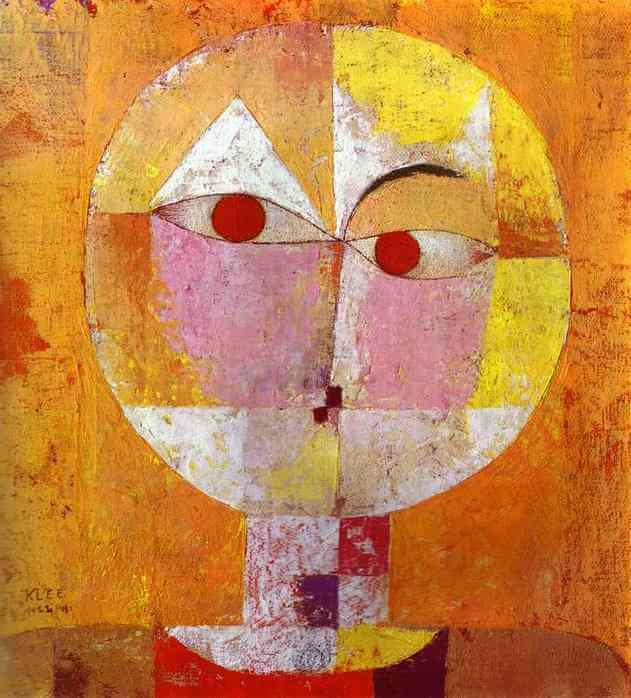
The painting presents a frontal human figure whose circular head dominates the composition. The face is constructed from geometric planes in shades of yellow, pink, white and ochre, while two almond-shaped eyes, marked by red centers, draw the viewer’s gaze. A vertical band organizes the center of the face and suggests a stylized nose; below it, a small dark rectangle represents the mouth. The form continues into a vertical neck or body composed of blocks of color, surrounded by an irregularly textured orange and ochre background. The result is a direct, quiet and enigmatic portrait.
Known as Senecio, the work belongs to Paul Klee’s world, where the human face becomes a sign, a mask and a structure of color. Rather than presenting a naturalistic physiognomy or a detailed individual identity, the painting reduces the figure to essential relationships between shapes, lines and colors. The frontal head thus becomes an iconic presence: we recognize a human figure, yet also contemplate an autonomous visual construction. This tension between the figurative and the abstract places the work within the modern exploration of faces, signs and simplified figures.
The red eyes serve as the psychological core of the portrait. Their symmetry and chromatic intensity fix a frontal gaze that regards the viewer without expressing any specific emotion. Divided into contrasting fields, the face replaces realistic modeling with an identity made of carefully balanced fragments. The almost circular head takes on the character of an abstract mask: it retains the basic features of a face but separates them from naturalistic individuality. The lower extension reinforces this impression, turning the figure into an almost totemic, stable and vertical presence. The composition thus concentrates the human presence in an elemental and memorable image.
The composition is organized around a central axis that aligns the forehead, nose, mouth, and lower body. This axial structure creates a sense of symmetry, although the fields of color introduce variation and keep the overall effect from seeming mechanical. Dark outlines define the eyes and other features, making the gaze stand out against the warm surfaces. The orange and ochre background envelops the figure and extends its chromatic energy, while the whites, violets, pinks, and reds create visual pauses within the face. The painterly texture of the background contrasts with the geometric clarity of the head and draws attention to the central mask.
In Senecio, Paul Klee turns a face into a system of visual signs. The transformation of figures and physiognomies through geometry, lines, and fields of color is a recognizable feature of his artistic language. The work needs neither gesture nor narrative to command attention: the frontal pose, red eyes, and division of the face create an image suspended between portrait, mask, and emblem. Each color helps construct the figure’s identity, while the vertical axis keeps the head connected to the body. Its balance of symmetry, fragmentation, and gaze makes the figure persistently enigmatic and draws the viewer’s attention back to the center of the face again and again.
Have questions about our oil painting reproductions? See our frequently asked questions.