

Description
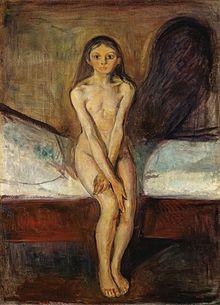
The painting shows a nude human figure with a youthful appearance, positioned frontally at the center of the composition. Long hair frames the face and torso, while the hands clasped in front of the body create a gesture of restraint and introspection. Behind the figure, two large dark forms with a feather-like texture spread out to either side and fill much of the space. The background is built up from horizontal bands and planes in cream, ochre, brown, earthy red, and grayish blue. At the bottom, a dark reddish band reinforces the visual weight of the scene and sets the figure apart against a dense, somber setting.
The title, Puberty, places the work on the threshold between childhood and maturity: a stage marked by physical transformations, hormonal changes, sexual awakening, and a more intense awareness of one’s own identity. Nudity functions not merely as anatomical exposure, but as a way of presenting the body in the process of change, vulnerable and fully visible. In the sensibility of modern art, the human figure can express an inner experience rather than depict a specific person. Thus, the scene concentrates in a single body the tension inherent in a major life transition that simultaneously affects appearance, self-perception, and one’s relationship with the world.
The frontal composition turns the figure into an axis of silent presence. The joined hands suggest reserve, self-control, or a conscious, expectant stillness, while the upright posture keeps the body exposed without turning it into a scene of action. The dark forms stretching behind the figure can be read as a symbolic extension of it: they evoke impulses, instinctive forces, or an unease growing around the body. Their feathery texture introduces an almost winglike quality, but one that is also ambiguous and menacing. The contrast between this lateral expansion and the figure’s restrained gesture reinforces the opposition between inner growth and vulnerability. The bands in the background, in turn, transform the space into a psychological setting, closer to mental tension than to a specific narrative place.
The vertical composition focuses the viewer’s gaze on the central body, which occupies almost the entire height and establishes a stable line against the diagonal movement of the dark forms. This structure creates an unstable balance: the figure remains motionless, while the background seems to open up and stir around it. The warm colors of the skin and the lower planes contrast with the deep browns, black, and grayish blue, creating localized illumination on the body. The dense brushwork and the background’s layered arrangement eschew naturalistic depth; instead, they build a compact surface charged with texture and tension. The eye returns again and again to the face, hands, and outline of the torso before moving toward the expansive forms surrounding it.
In relation to Edvard Munch, the work reflects a sensibility characterized by psychological intensity, expressive use of color, and the simplification or distortion of forms to address anxiety, sexuality, and human vulnerability. Puberty transforms a bodily moment into an experience of inner exposure: the body is still, but everything around it suggests change. It is worth paying particular attention to how the restrained hands and dark forms depend on one another: the hands concentrate fragility at the center, while the forms turn that fragility into a broad, unsettling presence that is difficult to separate from the process of maturation itself.
Have questions about our oil painting reproductions? See our frequently asked questions.