

Description
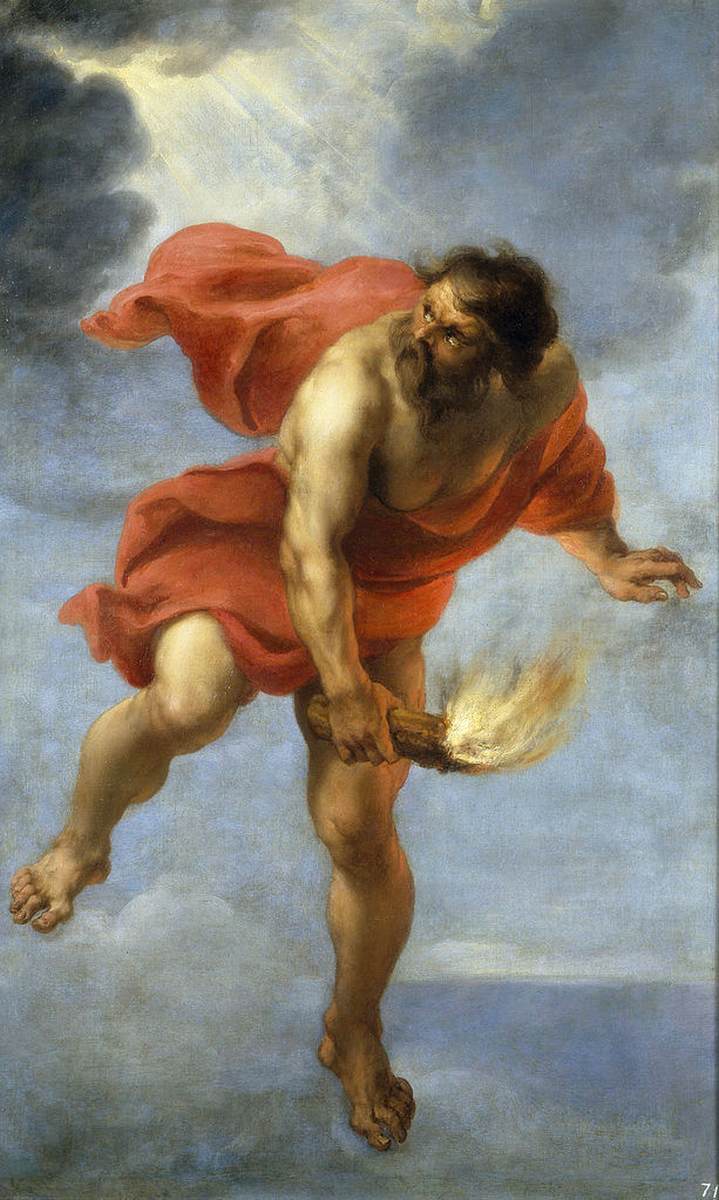
The painting shows Prometheus crossing a celestial space, suspended along a powerful diagonal that leads the eye from the red drapery at the top to the flame in the lower right corner. The protagonist is a muscular, bearded adult man, with his torso partially exposed and his body extended in mid-motion. One hand reaches toward the right edge, while the other holds a dark object from which a yellow-and-white flame bursts forth. The orange-red fabrics billow behind his shoulders, wrap around his waist, and trail alongside his legs, as if the wind were contributing to the figure’s momentum. The scene unfolds against a grayish-blue sky filled with dense clouds and luminous openings.
The scene alludes to Prometheus, the Titan in Greek mythology associated with stealing fire from the gods and giving it to humankind. The episode transforms a mythical act into an image of passage: the fire is not shown in isolation, but carried with effort through a grand, supernatural realm. In this story, the flame represents far more than a source of heat. It is associated with knowledge, civilization, and human progress, giving the protagonist’s gesture a collective significance. The heroic figure carries a force capable of transforming the lives of those who receive it.
The flame concentrates the composition’s narrative and chromatic meaning. Its intense yellow and white reflections stand out against the cool tones of the sky, making it the focal point of visual tension. The red drapery extends that warm energy around the body and reinforces ideas of movement, danger, and vital force. The figure’s dominant scale presents him as a titanic presence, while his beard, musculature, and open stance reinforce his heroic character. The cloudy sky serves as a setting that separates him from the everyday world: the fire appears in an elevated, almost cosmic realm before becoming an emblem of human experience.
The formal construction depends on diagonals, curves, and contrasts. The extended leg guides the eye downward; the other, bent toward the left, introduces tension that keeps the body from becoming static. The red folds form broad rhythms around the anatomy and balance the direction of the outstretched arm. In contrast, the clouds are arranged in irregular masses of grayish blue and dark gray, opened up by patches of diffused light. This atmospheric background deepens the space and makes the figure appear to stride above a limitless landscape. The lighting focuses attention on the skin, the fabrics, and the fire, shaping an opposition between celestial coolness and incandescent heat.
The work is associated with Jan Cossiers’s Flemish Baroque style, particularly with a tradition of history and mythological painting characterized by figures with a powerful physical presence, dramatic movement, vivid color, and contrasts of light. Here, these devices transform the myth into a vision of almost cosmic force: Prometheus is not simply beside the fire, but seems to be traversing the sky with it. As you look at the painting, follow the diagonal path from the billowing drapery to the small flame; along this path, you can see how the heroic body, color, and atmosphere transform the gift of fire into a scene of energy, danger, and the promise of civilization.
Have questions about our oil painting reproductions? See our frequently asked questions.