

Description
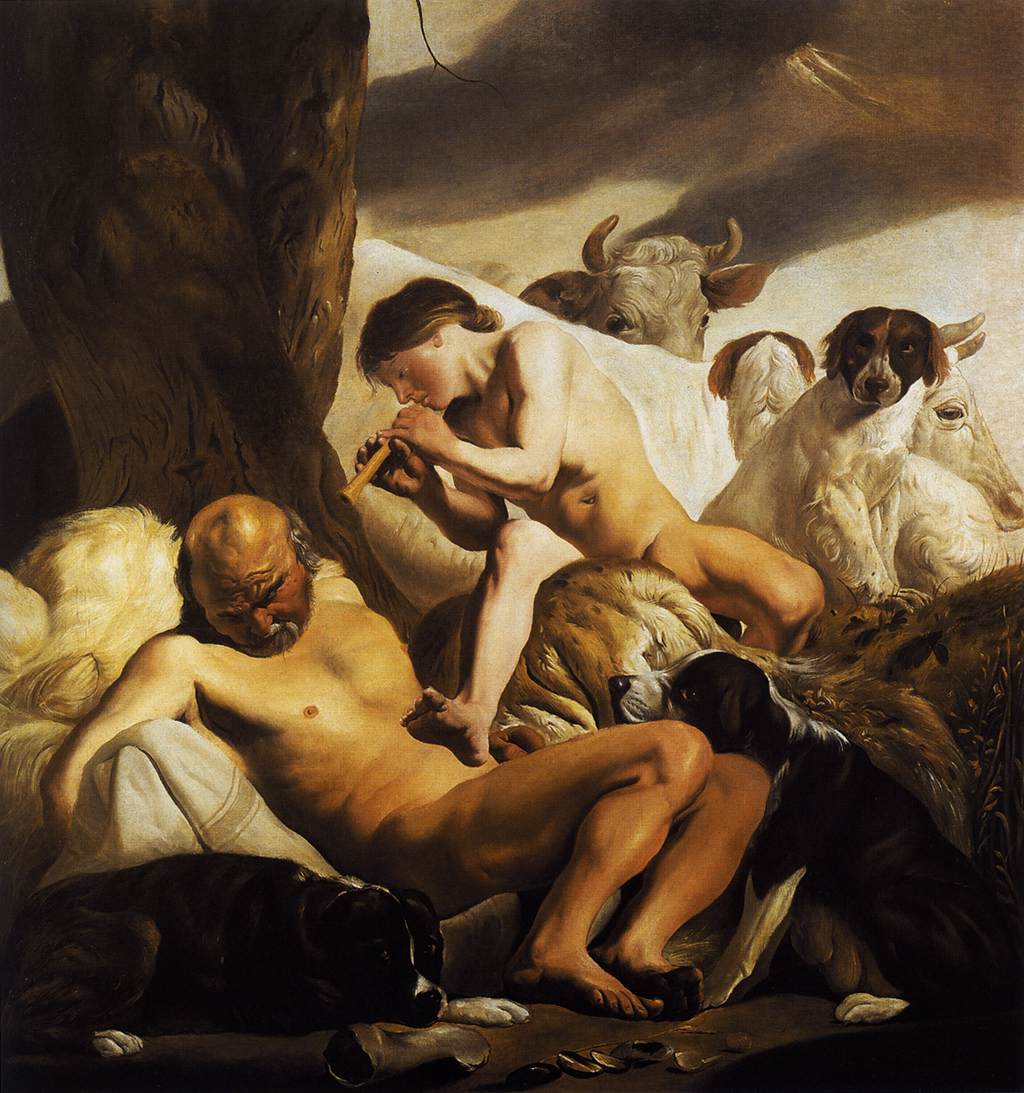
The painting depicts Mercury, Argus and Io in a pastoral landscape charged with dramatic tension. At the center, a nude human figure leans forward and holds a small flute or pipe beside the face, focusing attention on the musical gesture. In front of this figure, another nude figure lies reclining on a light-colored cloth, legs outstretched and body integrated into the foreground. A group of animals gathers around them: cattle with visible horns, woolly bodies and dark animals resting among the rocks and on the ground. A large, rough-barked trunk dominates the left side, while the hills on the horizon and the overcast sky open the scene onto a dark, mountainous landscape.
The episode belongs to the mythological cycle of Io, Jupiter and Juno. Jupiter transforms Io into a heifer to conceal her, but Juno commissions Argus, the many-eyed guardian, to watch over the animal. Mercury arrives to free Io and uses music to lull Argus to sleep before killing him. The painting brings this narrative moment together in an image with a pastoral appearance: the herd and landscape might suggest a tranquil scene, but the presence of the musician and the defeated figure introduce a silent threat. Io’s transformation makes the cattle the mythological focus of the composition, beyond their role as elements of the setting.
The small flute serves as a narrative attribute of Mercury and establishes a direct link between sound and Argus’s sleep. The reclining figure, surrounded by animals and placed in a vulnerable position, can be read as the defeated or drowsy guardian. Around them, the herd transforms the natural setting into a stage for vigilance and deception. The large tree acts as a dark axis framing the action, while the stormy sky heightens the sense of isolation. The contrast between the delicate music, merely suggested by the instrument, and the compact mass of animal bodies creates a sense of restrained tension: Mercury’s cunning unfolds without grand gestures, in a suspended moment.
The composition is arranged diagonally. The vertical trunk anchors the left edge and leads the eye toward the central figure; from there, the human and animal bodies form a visual chain that moves to the right and descends toward the foreground. The reclining figure provides a horizontal line that contrasts with the musician’s slant and the tree’s verticality. Dark brown, black, ochre, and cream create an earthy palette, interrupted by the light-colored fabric and the illuminated areas of the bodies and animals. The warm light is concentrated on the main group, while the dense clouds and mountains are rendered in shades of gray and brown. This contrast shapes the depth and makes the episode seem to emerge from a landscape in twilight.
The work can be situated within the Dutch Classicism associated with Jacob van Campen, particularly in its ambition as a mythological history painting, the clarity with which it arranges the figures, and its dramatic use of light and landscape. Here, the relative scale of the figures, the tree trunk, and the animals creates a monumental scene despite its spatial compactness. The result brings together classical narrative and rugged nature: Mercury’s music anchors the composition, Argus introduces the theme of sleep, and the cattle keep Io’s identity in view. Notice how the gaze moves from the instrument to the reclining figure and then to the herd; along this path, the painting turns a minimal gesture into the turning point of the entire narrative.
Have questions about our oil painting reproductions? See our frequently asked questions.