

Description
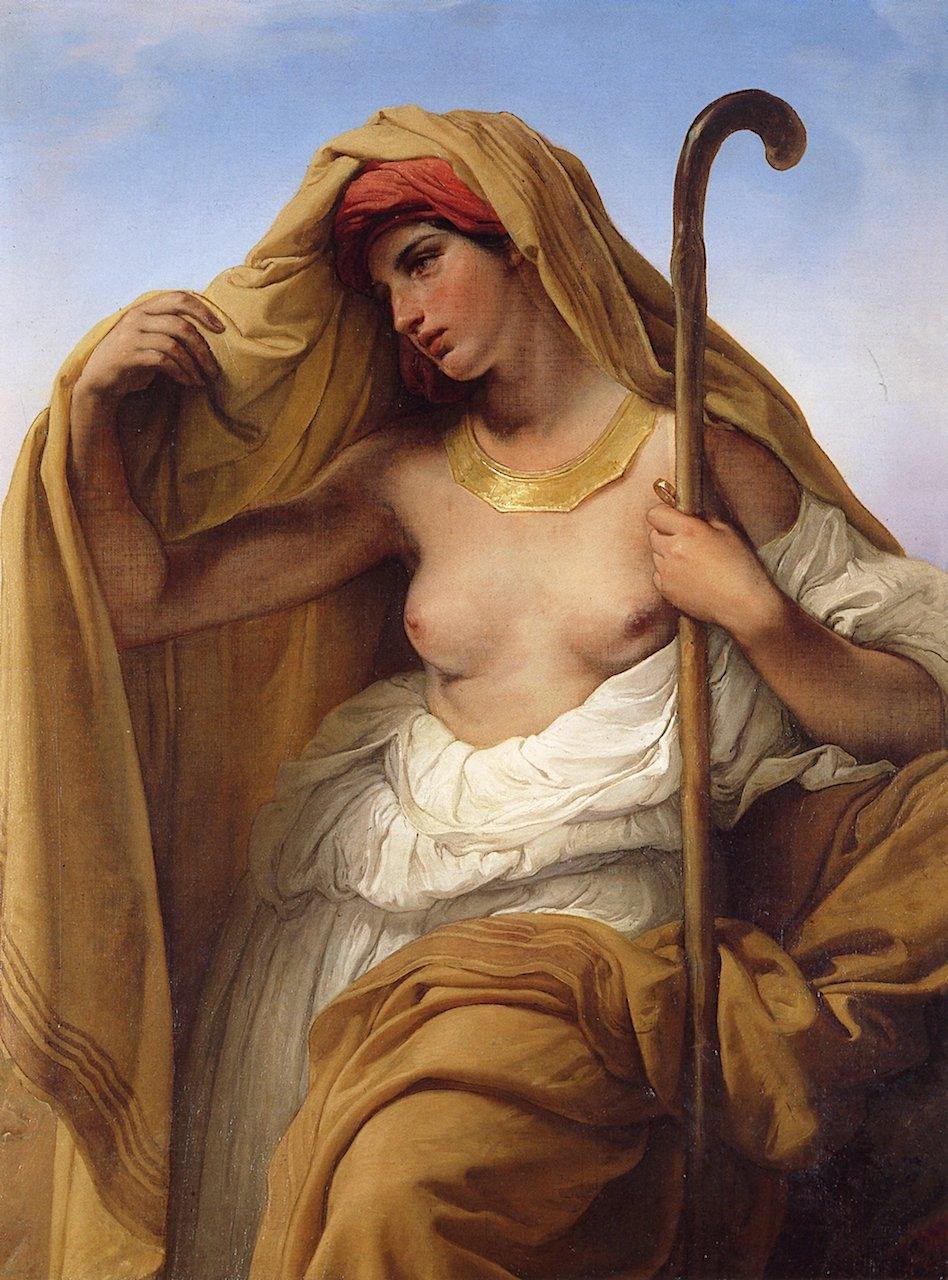
The painting shows Tamar of Judah seated at the center of the composition, presented as a figure of monumental, silent presence. She tilts her head to the left and lowers her gaze, while a red headdress peeks out from beneath a wide golden veil that frames her face and falls on either side of her body. A broad, gold-toned necklace stands out against her torso; white, ochre, and brown fabrics gather around her lap and legs, forming a dense covering of folds. In her right hand, she holds a vertically positioned wooden staff with a curved top, while her other hand lifts the edge of her mantle. Behind her, a wooden structure stands out against a pale blue background resembling an open sky.
Tamar is a figure in Genesis and the daughter-in-law of Judah. After becoming a widow, she resorted to a disguise to meet Judah and ensure the continuation of his line; their union produced Perez and Zerah. The scene thus takes on a narrative dimension connected with identity, concealment, and perseverance within the biblical account. The work does not present the episode as a fleeting action, but as an image focused on the dignity and solemnity of its protagonist. The stillness of her pose invites us to contemplate Tamar as a woman caught between an experience of vulnerability and a steadfast determination to preserve her lineage.
The golden veil evokes the concealment associated with Tamar’s story and also plays a decisive visual role: it frames her head, broadens the silhouette, and draws attention to her bowed face. Her lowered gaze and seated pose convey contemplation, introspection, and restrained strength. The staff serves visually as both a support and an axis that stabilizes the scene, without imposing itself as a narrative emblem. Its verticality contrasts with the gentle diagonal descending from her head to her lap. Through the red of her headdress, the gold tones of the veil and necklace, and the interplay of whites, ochres, and browns, Tamar’s identity is built up through layers of color and textile textures.
The composition is vertical and centered, with the figure occupying almost the entire pictorial field. The veil acts as an inner frame, focusing the gaze on her face and torso, while the staff introduces a straight line that structures the right side. By contrast, the tilt of her head and the fall of the fabrics create a gentle, unhurried diagonal movement. The light blue background opens up a luminous space around the figure, but the wooden structure on the left and the gathered fabrics keep the scene from dissolving: the body remains compact, close, and dominant. The clear, warm lighting enhances the golden tones and the modeling of the face, balancing solemnity with a sense of tangible presence.
In keeping with the language of Italian historical Romanticism associated with Francesco Hayez, the work combines careful draftsmanship, rich coloring, and a composition designed to heighten the character’s dramatic and narrative dimension. Its theatricality does not depend on an expansive gesture, but on the calculated arrangement of the veil, fabrics, and staff around a restrained figure. Tamar thus appears as a monumental, silent presence: a veiled identity asserted through her posture, attributes, and scale within the space. Particular attention should be paid to the meeting of her lowered gaze and the staff’s vertical axis; at this intersection, biblical gravity is transformed into an image of resistance, introspection, and quiet strength.
Have questions about our oil painting reproductions? See our frequently asked questions.