

Description
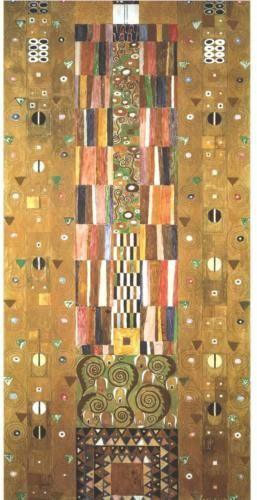
The painting presents a narrow, vertical, almost axial ornamental design, arranged around a central column of bands, rectangles, circles and small repeating motifs. Black, white, red, green, yellow and brown blocks alternate along the axis, while the sides display circles, semicircles, triangles, squares and diamonds against a golden ochre background. The lower area carries the greatest visual weight: large circular forms with concentric spirals are set over a triangular field containing a central square. The composition, titled Design for the Stoclet Frieze, does not depict a conventional figurative scene; instead, it creates a decorative world through rhythm, symmetry and repetition.
The Stoclet Frieze is part of the decorative program of the Palais Stoclet in Brussels, a project closely associated with Gustav Klimt and the visual language of the Vienna Secession. In this context, the work is understood as a design intended to form part of a broad architectural conception, in which painting, ornament and built space engage in a dialogue. Its appeal lies in transforming the surface into an autonomous visual structure, capable of directing the viewer’s gaze through modules and contrasts. The reference to the frieze places the geometric motifs within a decorative tradition that gives pattern as much importance as any recognizable representation.
The lower spirals introduce a sense of expansion and movement into a composition dominated by geometric discipline. Their concentric curves act as centers of energy, contrasting with the squares, triangles, and rectilinear bands of the central axis. The repetition of circles and diamonds on either side creates a reading reminiscent of ornamental fabric: each motif retains its identity while also contributing to a larger unity. The vertical axis functions as a ceremonial column that connects the different registers, while the lower triangular field concentrates and brings the visual journey to a close.
The composition is held together by an approximate bilateral symmetry, although variations in color and size prevent it from feeling mechanically rigid. The golden ochre background unifies the surface and gives the black outlines, creamy whites, and brick reds a distinct presence. Muted greens, yellows, and grayish blues introduce chromatic pauses that enrich the interwoven pattern without disrupting its coherence. Depth depends not on traditional perspective but on the overlapping bands, blocks, and decorative fields. The eye travels up the narrow central axis, then descends toward the spirals, where the rhythm becomes more enveloping and compact.
In relation to Gustav Klimt, this design brings together essential features of a decorative language based on sumptuous surfaces, geometric patterns, and stylized organic forms. The work functions as a miniature visual architecture: a system of bands and repeated motifs in which color, line, and proportion take the place of traditional narrative. Notice how the lower curves balance the overall verticality and how the golden background transforms each figure into part of a continuous surface. In this way, the Stoclet Frieze emerges as a rhythmic, ceremonial composition in which ornament is not an addition but the very structure of the painting.
Have questions about our oil painting reproductions? See our frequently asked questions.