

Description
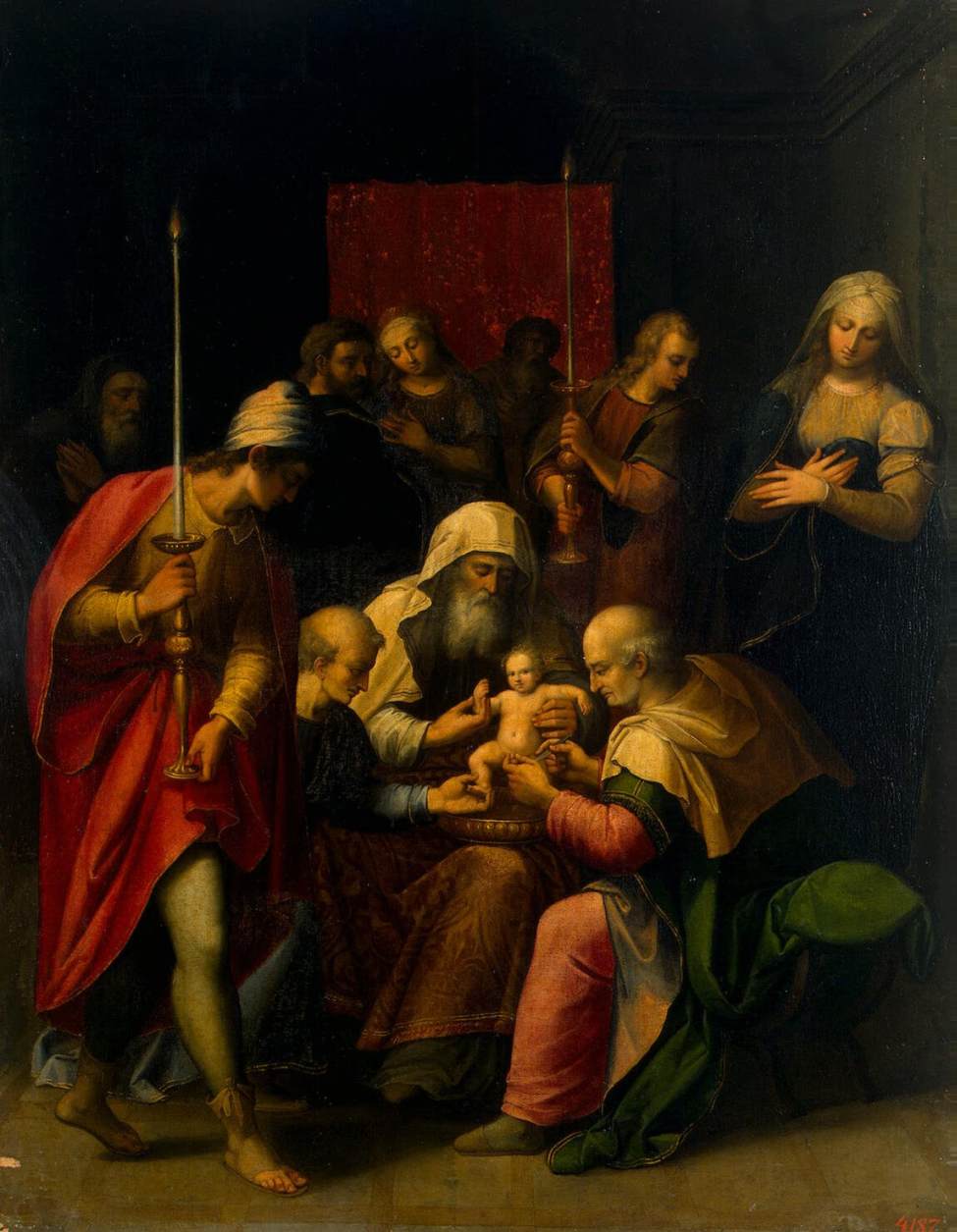
The painting depicts the Circumcision of Christ as a ceremony focused on a naked child, positioned in the lower center and held above a circular vessel. 11 adult figures gather around him: some lean toward him, others clasp their hands in devotion, and 2 carry tall, lit candles. An elderly figure with a white beard occupies the central axis, while a woman in a light-colored veil stands to the right, slightly apart from the ritual gathering. The interior is shrouded in shadow, with a red curtain in the background, barely visible architectural moldings and a large green cloth spread across the lower-right corner. The scene brings together touch, prayer and anticipation in an intimate, theatrical setting.
In Christian tradition, the circumcision of Jesus is associated with the rite performed on the 8th day after his birth, as recounted in the Gospel of Luke. The episode is part of the scenes from the childhood of Christ and alludes to his incorporation into Jewish tradition. Depictions of this subject often bring together the child, family members and an officiant in a ceremonial setting. Here, the attendees’ collective arrangement turns the central act into a solemn event: every gaze, hand and gesture converges on the child, who appears surrounded by a community of witnesses.
The child serves as the narrative and devotional focus precisely through the contrast between his nakedness and the adults’ heavy garments. His vulnerability is heightened by the circle of hands supporting him, pointing toward him, or reaching out to him. The bearded figure holding him takes on the visual weight of a celebrant or protagonist of the rite, while the veiled woman lends the scene a familial and emotional dimension. The lit candles reinforce the scene’s liturgical character and draw attention from the earthly group toward a spiritual interpretation. The red drapery and the ochre, gold, and green garments lend the scene ceremonial richness, set against the darkness.
The vertical composition is densely structured by the diagonals of the leaning figures and the two straight lines of the candles. This balance between movement and verticality guides the eye from the upper faces to the child and the vessel beneath him. The dark background absorbs secondary contours and concentrates the light on the hands, faces, and folds of the fabrics. Crimson and gold tones serve as warm accents, while blacks and browns create an enclosed, almost theatrical depth. The overlapping figures create a sense of physical closeness: there is no contemplative distance, but rather a collective presence surrounding and protecting the center of the action.
In this work by Luis De Carbajal, the intensity depends not on a landscape or monumental architecture, but on the gathering of people and the contrast between shadow and warm light. The painting transforms a ritual episode into an intimate devotional drama, in which solemnity arises from the concentration of gestures and the care with which each figure turns toward the child. Notice how the candles balance the group and how the red drapery frames, without completely isolating, the heart of the ceremony. Here, religious subject matter, physical vulnerability, and chromatic theatricality come together: the rite becomes visible as a scene of community, attentiveness, and spiritual significance.
Have questions about our oil painting reproductions? See our frequently asked questions.