

Description
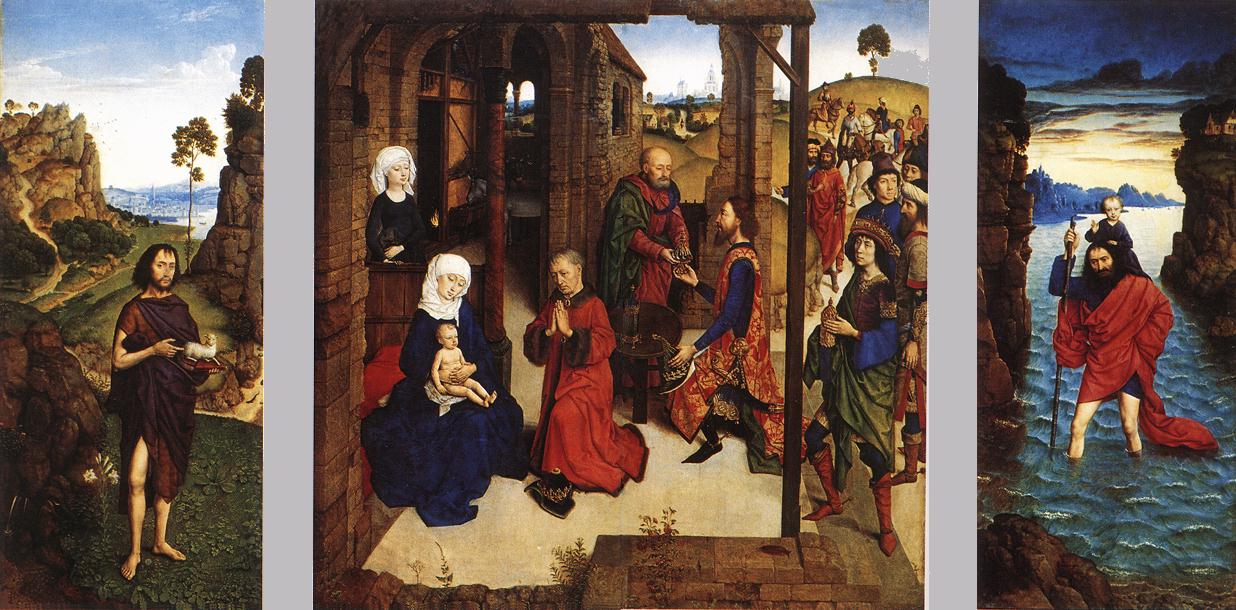
This devotional triptych brings together a central interior scene and two lateral landscapes. In the main panel, a veiled woman holds the Child on her lap inside a stone structure, surrounded by adult figures wearing tunics, cloaks, and head coverings, and displaying attentive gestures. Arches, columns, beams, and a paved path structure the space, which opens onto a group of people and distant buildings. In the left wing, a barefoot, bearded man holds a small lamb among rocks, trees, and a sunlit valley. In the right wing, another bearded man, covered by a red cloak, crosses the water with a child seated on his shoulders.
The Virgin and Child occupy the center of the composition and focus the religious contemplation of the ensemble. The figures at the sides are identified by traditional attributes: the lamb links the figure in the rocky landscape to Saint John the Baptist, while the crossing of the water refers to Saint Christopher carrying the Christ Child. On the wings of an altarpiece, saints can serve as intercessors and protectors alongside the Marian theme. Thus, the central architecture provides a setting for sacred gathering, while the open landscapes extend the scene into the realms of the journey, retreat, and passage.
The lamb serves as a distinguishing attribute and links the isolated figure with the idea of proclamation and preparation. Saint Christopher’s gesture turns the water into a place of trial, crossed with determination, while the child on his shoulders evokes care and protection. The woman and baby form a center of stillness amid a more dynamic group, while the paths and currents extend the devotional experience outdoors. The interplay of stone shelter, rock, and water articulates a spirituality in which contemplation coexists with movement and protection.
The wider central panel has the greatest narrative density and establishes the triptych’s visual axis. The lines of the arches, columns and pavement guide the eye toward the woman and Child, while the secondary figures create a sense of depth. The side panels provide visual pauses: the saint standing beside the lamb is set against an open valley, while the figure of Saint Christopher introduces a vigorous diagonal across the undulating surface. Deep blues, crimson reds, dark greens, ochres and stone greys link the three scenes. Light spreads across the landscapes and becomes more subdued beneath the architecture, reinforcing the contrast between interior shelter and the outside world.
The Pearl of Brabant creates a continuous visual experience that brings together sacred presence, landscape and water. The composition combines life-size figures with enveloping architecture and horizons that extend the scene into a spiritual geography. The center focuses on an image of protection; the wings introduce difficult paths, rocks, storm and current. This interplay of stillness and movement unifies the whole and guides the eye from one panel to the next, turning the triptych into a visual meditation on care, pilgrimage and contemplation.
Have questions about our oil painting reproductions? See our frequently asked questions.