

Description
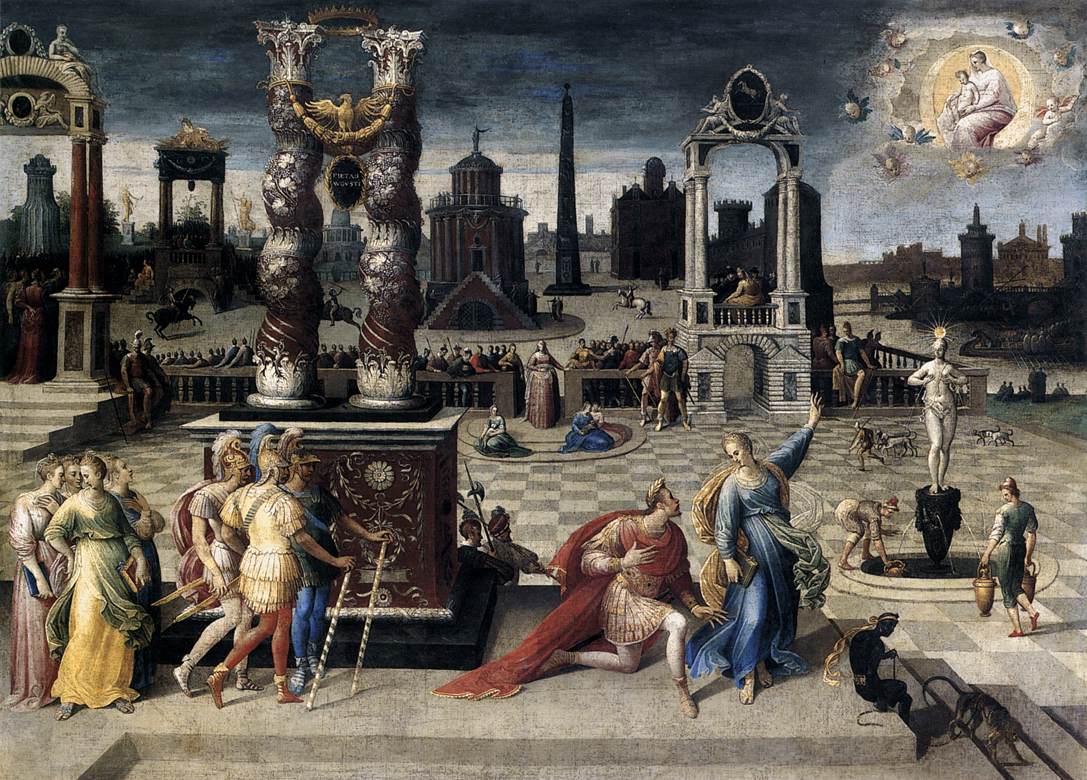
The painting depicts Augustus and the Sibyl in a monumental square with a Roman character, conceived as an open, densely populated stage. The checkerboard pavement draws the eye among soldiers in armor, women in long dresses, kneeling or reclining figures, and groups gathered beside the balustrades. Two enormous Solomonic columns dominate the foreground, while an obelisk rises along the central axis and a stone arch shapes the space on the right. Temples, towers, palaces, and city walls frame an imaginary city of grand proportions. Dogs and other animals wander through the square, adding an everyday note amid the ceremony. High above, a seated woman with a child receives the light among clouds and small winged figures.
The episode alludes to the legend of Augustus and the Tiburtine Sibyl. According to this Christian tradition, the Sibyl announces or reveals to the Roman emperor the future coming of Christ through a vision of the Virgin and Child. The scene thus links the authority of imperial antiquity with a revelation that transcends earthly power. Augustus embodies public order, architectural magnificence, and the ceremonial dimension of the Roman world; the celestial apparition introduces a sacred truth that redirects the meaning of the entire square. The crowd witnesses an event that connects human history with the promise of the Incarnation.
The iconography is structured around contrasts. The pair of columns, the obelisk, and the arch evoke the permanence of the empire, yet their stone solidity is subordinated to the luminous focus of the sky. The Virgin and Child form the spiritual heart of the story, while the winged figures reinforce the celestial and revelatory nature of the apparition. On the lower level, the gestures of the kneeling figures, the presence of soldiers, and the gathering of spectators turn a prophetic vision into a collective spectacle. The female statue on the right extends the plaza’s repertoire of images and creates a counterpoint between earthly sculpture and the living presence appearing among the clouds.
The panoramic composition is organized through a powerful network of lines and scales. The paving stones create a perspective that advances from the lower edge toward the obelisk and the buildings in the background, while the central columns serve as a vertical frame for the narrative. The arch and balustrade introduce horizontal rhythms that balance the profusion of figures. The architecture’s blue-gray and gray tones create a cool, solemn foundation, interrupted by golden ochres, dark reds, and blue-greens in the garments, armor, and accessories. Against this earthly density, the ivory white and brightness of the celestial area establish the main visual focus. Depth depends both on perspective and on the succession of small episodes that lead the eye across the entire plaza.
In Antoine Caron’s work, this monumental theatricality is associated with French Mannerism: dense compositions, elegant figures, and architecture with classical resonance combine to create refined, visionary, deliberately complex scenes. Here, the accumulation of details expands the legend into an urban and ceremonial experience. Observe how the paving leads the eye toward the apparition, how the columns frame the passage between the imperial world and the revelation, and how each group of people contributes to this tension. The work transforms a story of religious prophecy into a spectacle on an architectural scale, in which the crowd witnesses the moment when heaven changes the meaning of the city.
Have questions about our oil painting reproductions? See our frequently asked questions.